
Introduction
We are entering a slow season in which there aren't many new releases and while this may seem bad for some, it's actually a good time to reflect on what has been released since the start of 2019. It's also ideal time for some direct battles between the hottest flagships this Summer. Today's handsets under the spotlight are the runner-up OnePlus 7 Pro against the Samsung Galaxy S10+ - two large-screen, top-tier pro models that are definitely worth your attention and hard-earned money.
Why the OnePlus 7 Pro is the runner-up, you may ask. Well, even though before previous OnePlus devices were marketed as flagship killers, they always had to compromise on something to keep the price lower than your average flagship. "Bang for the buck" has always been an intrinsic value to OnePlus smartphones while the OnePlus 7 Pro is the first one to offer over-the-top features that you usually find in top-shelf smartphones. Budgeting isn't the main objective here and yet, it still undercuts the Galaxy S10+ and the rest of its competitors price-wise.
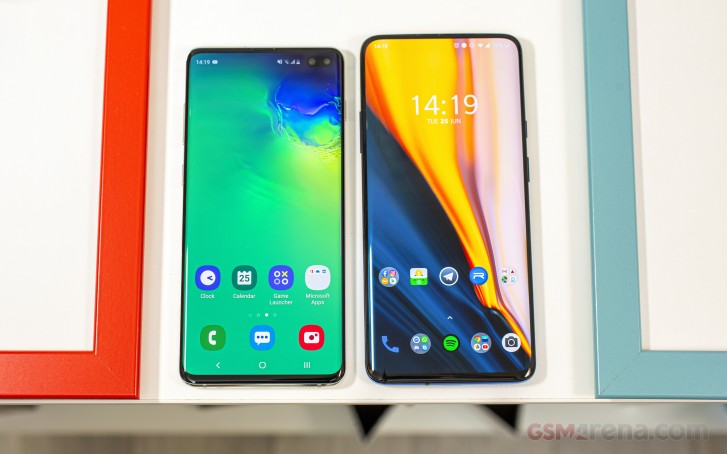
The Galaxy S10+, on the other hand, is one of the few zero-compromise flagships left around. It doesn't miss on some sought after features like proper ingress protection, microSD card support and audio jack. Things that the OnePlus 7 Pro is missing from its specs sheet. And for that, of course, Samsung is asking a price premium.
But as far as essentials go, these phones trade blows and check all the boxes. They both have big batteries, excellent large screens, powerful chips and versatile camera setups.
| Samsung Galaxy S10+ | OnePlus 7 Pro | |
|---|---|---|
| Build | Aluminum frame, GG6 front, GG5 back | Aluminum frame, GG5 front, GG5 back |
| Dimensions | 157.6 x 74.1 x 7.8mm, 175g | 162.6 x 75.9 x 8.8mm, 206g |
| Display | 6.4" OLED, 19:9, 1440 x 3040px, 522ppi | 6.67" OLED, 19.5:9, 1440 x 3120px, 616ppi |
| Rear camera | Main: 12MP, f/1.5-2.4, 26mm Telephoto: 12MP, f/2.4, 52mm 2x zoom Wide: 16MP, f/2.2, 12mm | Main: 48MP, f/1.6, 26mm Telephoto: 8MP, f/2.4, 78mm 3x zoom Wide: 16MP, f/2.2, 13mm |
| Front camera | Main: 10MP, f/1.9, 26mm Depth: 8MP, f/2.2 | 16MP, f/2.2 |
| Chipset | Snapdragon 855/Exynos 9820 | Snapdragon 855 |
| RAM; Storage | 8GB/12GB; 128GB/5125GB/1TB, microSD | 6GB/8GB/12GB; 128GB/256GB, no microSD |
| OS | Android 9.0 Pie, One UI | Android 9.0 Pie, OxygenOS |
| Battery | 4,100 mAh, 15W charging (QC2.0) | 4,000 mAh, 30W charging (Warp Charge) |
| Fingerprint reader | Under-display, ultrasonic | Under-display, optical |
| Misc | Stereo speakers, 3.5mm jack | Stereo speakers, no 3.5mm jack |
One thing that these phones do differently, however, is software. This is probably the main reason OnePlus fans keep going back to this brand. Slowly but surely OnePlus has established itself as one of the best software developers on the smartphone market by taking pure Android and tweaking only some of the things that really matter. And on the other side we have Samsung's brand new One UI that boasts simplicity and usability by applying a heavily-customized skin on top.
We will try to test how these phones go head to head in usual day to day scenarios and help you decide which one fits bets depending on your type of usage and priorities.
What's in these boxes
Both phones' retail packages offer all of the essentials but the Galaxy S10+ takes it a bit further. The handset comes with a plethora of adapters and accessories. Aside from the mandatory charging brick and USB-C to USB-A data cable also used for charging, the phone also comes with a pair of AKG earbuds with a 3.5mm plug and braided cables. They sound a lot better than your average in-ear headphones that come with other devices.
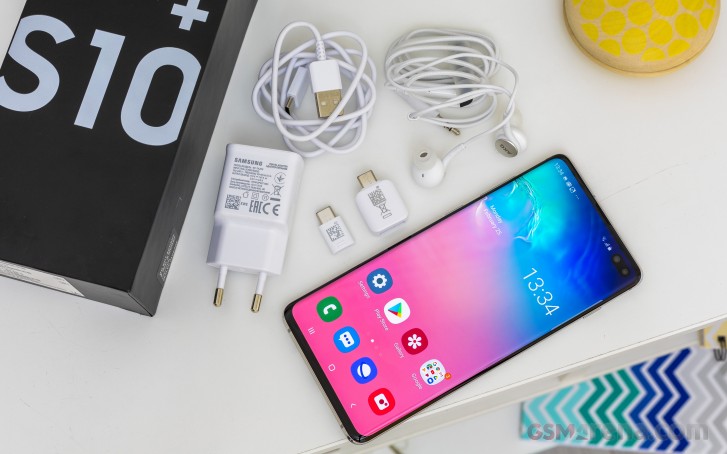
Additionally, Samsung has provided two handy adapters such as female USB-A to male USB-C and female microUSB to male USB-C. The first one can be used for OTG storage adapter while the second one will surely come in handy if you find yourself in a situation without a proper USB-C cable and have a microUSB one instead.
The OnePlus 7 Pro, on the other hand, lacks most of these accessories. We only have the 30W Warp charger in the box with the proprietary USB-C to USB-A cable and nothing else. No earbuds and even no USB-C to 3.5mm audio jack dongle despite the fact that the phone doesn't have a legacy audio port. Strangely, the OnePlus 6T did come with an adapter and we can't think of a reason why the OnePlus 7 Pro doesn't.
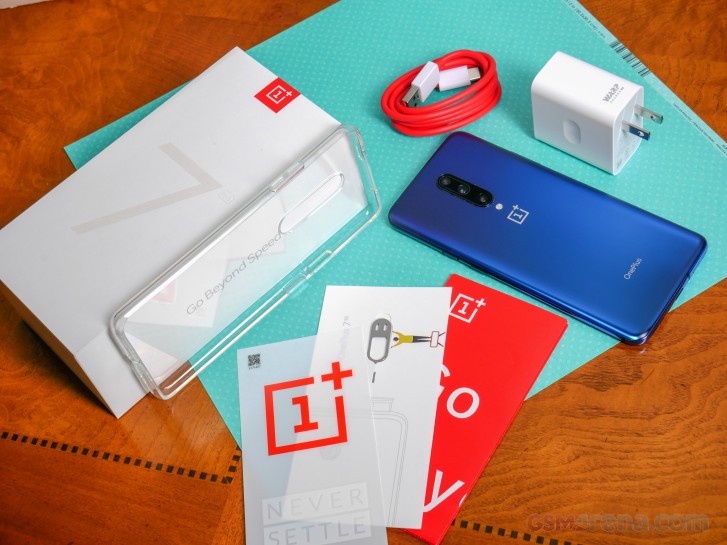
Winner: Without a doubt, the Samsung Galaxy S10+ gets all the points. The package isn't just complete but it offers some extra goodies on the side while the OnePlus 7 Pro lacks even a USB-C to 3.5mm dongle, which is inexcusable for a phone that lacks a standard audio port to begin with.
Design and build
Naturally, both phones being in the premium market segment, you'd expect impeccable build quality and ergonomics. And that's what you get here. OnePlus and Samsung both did a great job of designing these devices while following the latest market trends. The smartphones are build like glass sandwiches with a metal frame in the middle but the Galaxy S10+ uses Gorilla Glass 6 for the front and Gorilla Glass 5 for the back while the 7 Pro sticks with the latter for both sides.
Moreover, the Galaxy S10+ boasts actual IP68 rating against water and dust whereas OnePlus says the 7 Pro can withstand accidental drops in water and splashes easily but hasn't certified its handset as it would add up to the final price. And besides, the pop-up camera mechanism is probably a weak spot here. But on the other hand, we've seen a couple of videos on YouTube showing the OnePlus 7 Pro taking some serious dips like a champion. We don't recommend trying this at home though. IP rating or not - no water damage is covered by the warranty of either phone.
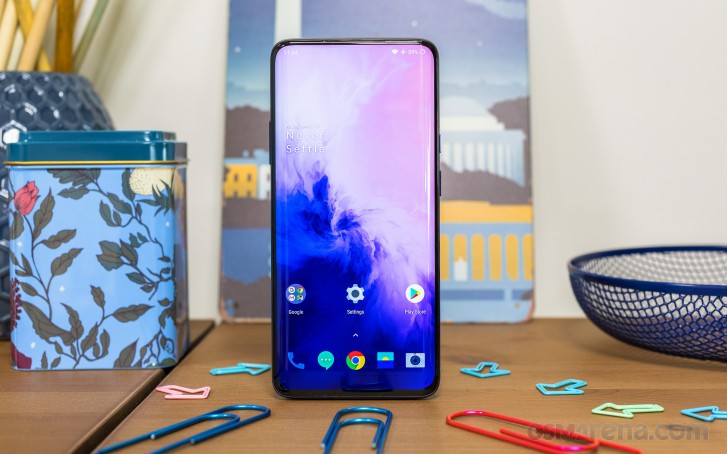
As we've already said, both devices are built excellently. There are no gap, protrusions or irregularities. Only premium materials have been used and the build quality is just spot on.
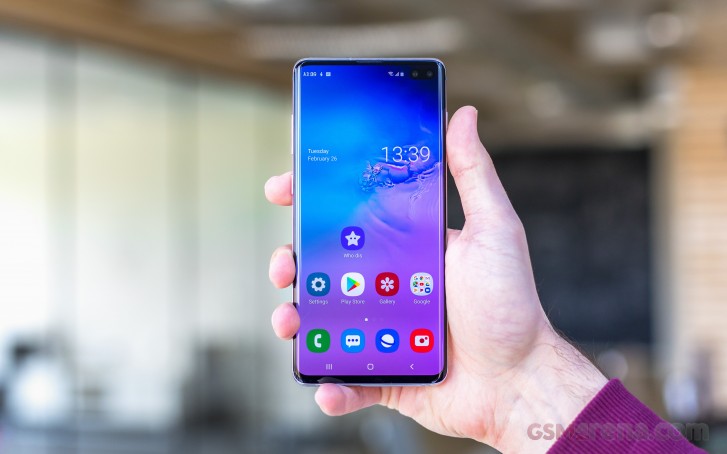
However, it has come to our attention that many OnePlus 7 Pro owners are complaining about being asked if that's a Samsung phone they are using. And we can't blame them. The Korean OEM has been doing curved screens before it was cool. From the front, it does look like the Galaxy S10+ but with a few notable differences.
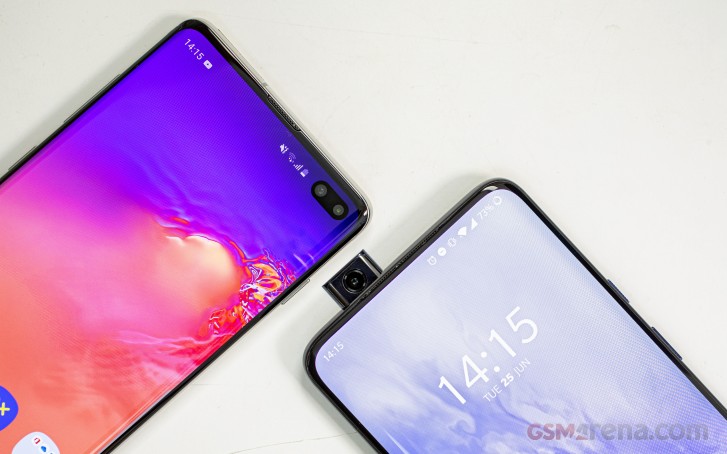
For once, the curvature of the screen is a tad more subtle and you can feel it. Secondly, there are no cutouts while the Galaxy S10+ has a fairly big one to accommodate for the dual-front facing cams. Also, bezels are a bit thinner on the 7 Pro.
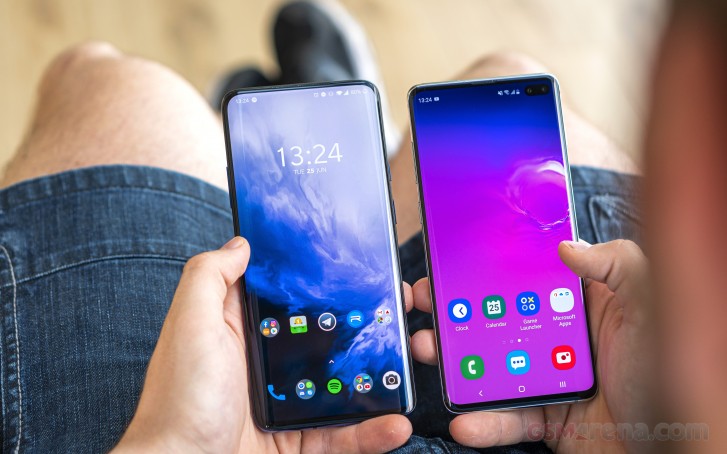
Dimensions-wise, the 7 Pro is thicker, wider, longer and considerably heavier. In return, you get more screen real estate. It fits a 6.67-inch display while the S10+ tops at 6.4". The 7 Pro is 8.8mm thick as opposed to the 7.8mm S10+ and OnePlus' contender is 162.6mm tall while the S10+ is 157.6. More importantly, though, the OnePlus 7 Pro is one hefty handset - it weighs 206g against the 175g on the Galaxy S10+. It might not sound a lot but you can definitely feel those extra grams. Also, the OnePlus 7 Pro doesn't seem to be that well-balanced and the weight tips over to the upper half of the phone. It might be due to the periscope-like mechanism for the selfie camera. It must add some extra weight.
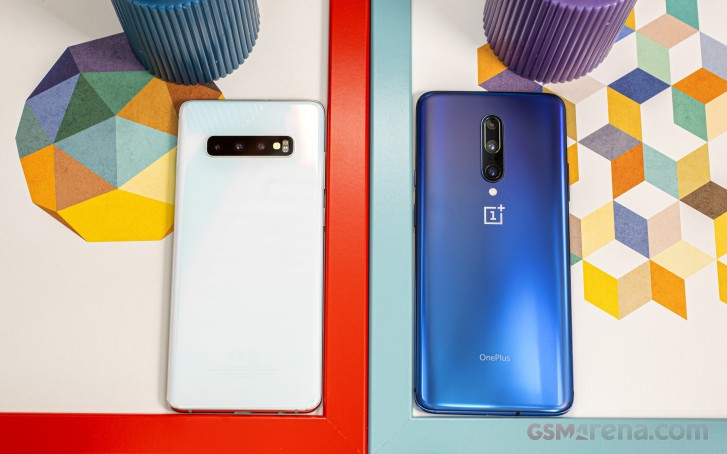
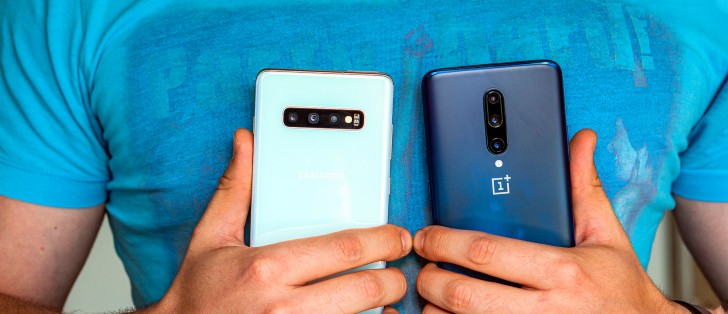
As far as the back design goes, the manufacturers have gone two separate ways. You still get the curves on the sides but the Galaxy S10+ sports an unusual horizontal camera alignment which protrudes just a little, whereas the 7 Pro goes with a more traditional vertical alignment.
Depending on which variant you choose, you either get a glossy finish with the Mirror Gray and Almond colors while the frosted matte glass finish is available only with the Nebula Blue paint job on the OnePlus 7 Pro. The Galaxy S10+ has a lot more color options but all of them are glossy.
Being comfortably positioned in the phablet category, both handsets can be considered as unwieldy. Sure, they are both big boys but the 7 Pro is taking things a bit further and the extra weight doesn't seem to help either. Interestingly enough, the curved edges on the back and front of both phones help with the one-handed operation quite a bit. Ergonomics are great, that's for sure. With the small exception of the power button on the S10+. It's a big phone and it's almost impossible to reach the button to lock the screen and there are no other alternative ways to lock it either. OnePlus' offering, for example, can be locked by double-tapping on an empty space on the screen.
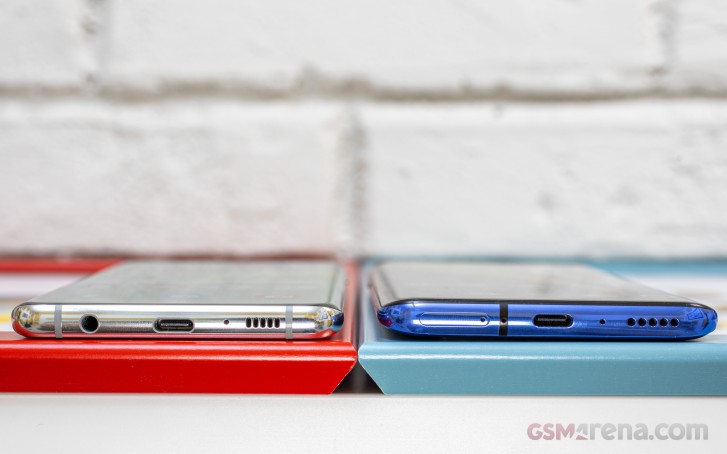
Winner: Tie. Firstly, design is a subjective matter and secondly, the 7 Pro and the S10+ both have impeccable build quality. The 7 Pro receives extra points for the pop-up camera mechanism allowing for a true full-screen experience while the Galaxy S10+ takes some praise due to its proper ingress protection. And vice versa - the S10+'s punch-hole camera design won't appeal to everyone while the weight of the 7 Pro can be considered as a drawback too.
Fluid and Dynamic OLEDs
Samsung has been the long-reigning champ in the display department. It's also the single biggest OLED supplier for smartphones these days. The Korean tech giant has always kept the good stuff for itself. Samsung flagship models have always been one step ahead in the game when it comes to OLED screens. They usually have the brightest and most color-accurate screens with as little color shift as possible.
However, OnePlus surprisingly has one-upped Samsung in their own game by delivering a phone with a similar curved QHD+ AMOLED screen as the Galaxy S10+'s but with a 90Hz refresh rate. That last feature has inspired the Fluid AMOLED name and even Samsung doesn't have a screen like that in its phones (yet).
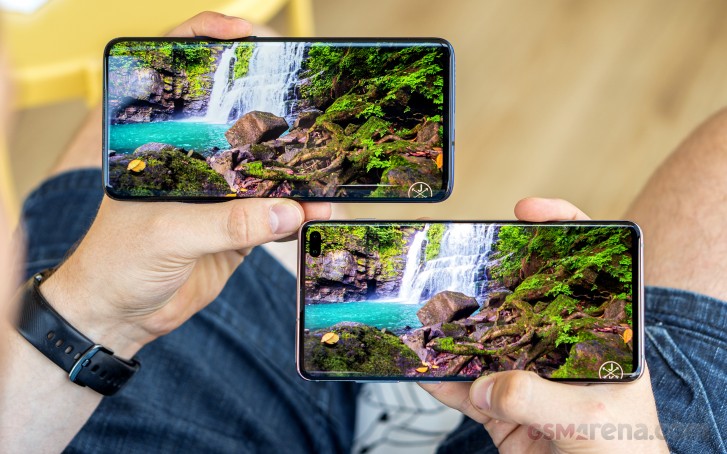
And looking at the results, it's hard to say which one is the clear winner. Sure, the S10+ offers a bit higher maximum brightness - by around 177 nits, which at this point isn't that big of a difference. But that buttery-smooth 90Hz refresh rate on the OnePlus makes for a great user experience. You won't feel it while watching static content or movies but navigating through menus, scrolling in apps, watching those animation transitions and playing games that support higher than 60 frames per second will spoil you in no time. Once you go 90Hz, you won't easily go back.
| Display test | 100% brightness | ||
| Black, cd/m2 | White, cd/m2 | ||
| 0 | 653 | ∞ | |
| 0 | 436 | ∞ | |
| 0 | 616 | ∞ | |
| 0 | 385 | ∞ | |
| 0 | 793 | ∞ | |
| 0 | 571 | ∞ | |
| 0 | 605 | ∞ | |
| 0.002 | 508 | 254000 | |
| 0.003 | 657 | 219000 | |
| 0 | 428 | ∞ | |
| 0 | 620 | ∞ | |
| 0 | 391 | ∞ | |
| 0 | 665 | ∞ | |
And while the Galaxy S10+ doesn't have 90Hz refresh rate, it does have one highly sought after feature - Always-on display. That's more of a software feature rather than hardware, but we felt you should know that the 7 Pro still doesn't have a true AOD.
Winner: The OnePlus 7 Pro. We never thought we'd say that but that Galaxy S10+ doesn't win this round. We went with the OnePlus 7 Pro because of its true full-screen experience, the bigger screen size, and that sweet 90Hz refresh rate. The Galaxy S10+'s panel is still the brightest one around but the rather big camera cutout takes away some of the viewing pleasure.
Battery life
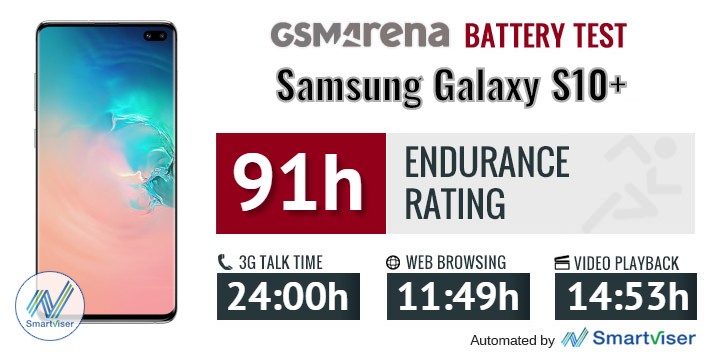
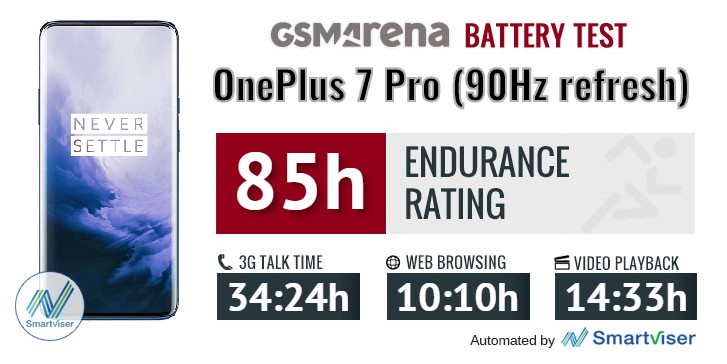
Those big boys sure as hell carry some big batteries with them. Still, Samsung's offering takes the lead with a slightly bigger 4100 mAh as opposed to the 4,000 mAh capacity on the 7 Pro. And one would expect a bit lower battery life on the OnePlus 7 Pro due to the larger screen and higher refresh rate. So we ran the tests in 90 and 60Hz modes and it turns out that 7 Pro comes out on top when you switch to 60Hz and falls short a few hours on our endurance score with 90Hz mode active.
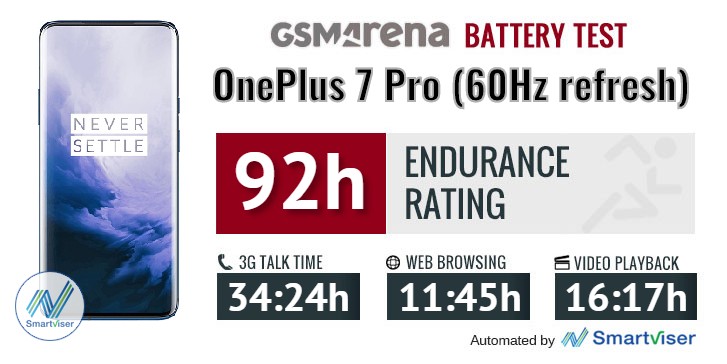
Feature-wise, things get interesting. OnePlus' specialty, fast charging, takes the cake in this race. Its Warp Charge caps at 30W and can charge the beefy 4,000 mAh battery from flat to 60% in just 30 minutes. And the good news is that it also supports the company's older 20W fast charging getting the battery from dead to 47% in 30 minutes. That's great news for previous OnePlus owners or even current ones that don't want to dig deep in their pockets for the faster charger. The old one will work just fine as a secondary option.
Samsung, on the contrary, only supports an older spec 15W Quick Charge 2.0 charging tech that can get you up to 41% in 30 minutes. But the phone offers fast (15W) wireless charging and also reversed wireless charging at (9W). Two nifty features that OnePlus' phone lacks.
Winner: Tie. It really depends on your style of use. If 90Hz isn't something you are after, then the Galaxy S10+ and the 7 Pro will grant you with pretty much the same endurance. Staying at 90Hz, the OnePlus drags behind a few hours in this regard. So it all boils down to whether you prefer fast charging or wireless charging. Obviously, go for the 7 Pro if fast charging is your thing or the Galaxy S10+ if you prefer leaving your phone on the charging pad without worrying about cables. Oh, and the reverse wireless charging, although gimmicky, might come in handy if your smartwatch is in dire need of juice.
Loudspeaker
As two full-fledged flagship models from 2019, both handsets sport stereo loudspeakers. One of the speakers is bottom-facing while the earpiece doubles as a loudspeaker on both devices.
According to our testing in a controlled environment, the OnePlus 7 Pro's speakers appear to be a bit louder in all three scenarios.
| Speakerphone test | Voice, dB | Ringing |
Overall score | |
| 69.8 | 74.5 | 81.0 | Very Good | |
| 70.3 | 73.4 | 83.8 | Very Good | |
| 70.5 | 74.0 | 84.7 | Excellent | |
| 74.4 | 74.2 | 83.6 | Excellent | |
| 70.9 | 73.8 | 90.9 | Excellent | |
| 79.6 | 77.7 | 87.2 | Excellent |
Nevertheless, upon further inspection and subjective listening, the S10+ sounds a bit louder when playing music from YouTube, for example. But it all could be due to tuning.
The Galaxy S10+ handles vocals and higher pitched sounds a bit better. The 7 Pro, on the other hand, produces fuller sound and it's more balanced in a way. You can feel the bass better - as far as bass goes on a smartphone, of course.
Anyway, both handsets offer additional Dolby Atmos tuning, but we didn't find any prominent enough changes to the music playback when cycling through the modes.
Winner: Tie. All in all, both flagships sound great with little to no difference in sound quality and loudness in general. More pretentious users might find some differences, but even they would agree that they aren't obvious in any way.
Audio quality
The two smartphones put in bright performances in the active external amplifier part of the test, posting perfect scores for clarity and delivering output of high volume. The OnePlus 7 Pro has a louder output than most phones out there but was still unable to match the Samsung Galaxy S10+.
Headphones did very little damage to either, but still managed to affect the intermodulation distortion and stereo crosstalk of the OnePlus 7 Pro. A minor thing really, but with this kind of competition even the smallest of shortcomings can leave you second best, and it's exactly the case here.
| Test | Frequency response | Noise level | Dynamic range | THD | IMD + Noise | Stereo crosstalk |
| +0.03, -0.01 | -93.0 | 92.6 | 0.0023 | 0.021 | -89.6 | |
| +0.10, -0.05 | -92.0 | 91.4 | 0.0034 | 0.106 | -74.8 | |
| +0.03, -0.05 | -93.0 | 92.8 | 0.0015 | 0.0070 | -94.3 | |
| +0.06, -0.03 | -92.7 | 92.5 | 0.0044 | 0.044 | -87.2 |
Winner: The Galaxy S10+. Both phones are excellent performers, but the Galaxy S10+ is the winner here with just a slight edge over its competitor.
Software - battle between stock and custom
The software department is where both phones part ways in their philosophy. Samsung takes the somewhat common path of other OEMs by taking the stock Android UI and completely overhauling it while adding tons of features on top. Diversely, OnePlus has won many of vanilla Android die-hard fans over the years.
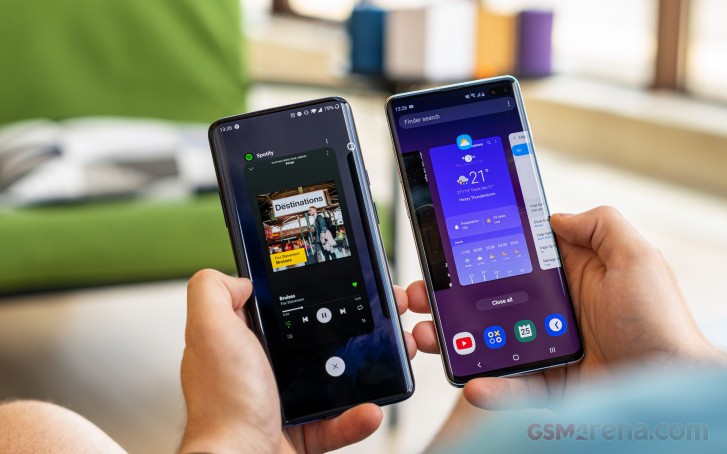
But OnePlus' OxygenOS isn't exactly pure Android. The company does add some features here and there but mainly keeps the software clutter-free and sticks to the overall stock Android aesthetics. More importantly, though, OnePlus has a couple of tweaks under the hood like improved CPU governor, streamlined animations and additional optimizations that remain invisible to the naked eye. That's why OxygenOS is touted as being among the fastest distribution of Android.
If you want to check out both, Samsung's One UI and OxygenOS in depth, we suggest visiting the full reviews. In this piece, we will be focusing mainly on day-to-day usage differences.
Let's start with Samsung's brand new One UI. The Korean OEM has taken a different approach with its software this year. One UI is more streamlined, focuses on the one-handed operation, and it feels more light. Native dark mode has been introduced as well so no need to dig into Samsung's app store for dark themes.
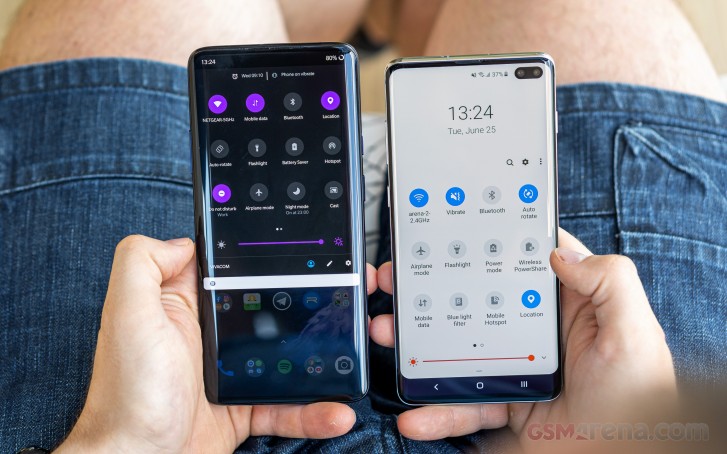
But two of the things that define Samsung's software has carried over the years over to One UI - an overwhelming amount of features (and we mean that in a good way) and plenty of bloatware although, it has been trimmed over the years. There are many options that you wouldn't find on the OnePlus 7 Pro like an always-on display, Edge panel and more granular control over the Edge lighting feature, which comes in handy since the Galaxy S10+ - like the 7 Pro - doesn't have a notification LED.
To be fair, the 7 Pro also has edge lighting feature but doesn't let you customize anything - you got just one color, one effect, it appears briefly (you can't set the duration) and doesn't seem to work with all apps. Perhaps future OxygenOS updates could bring extended functionality.
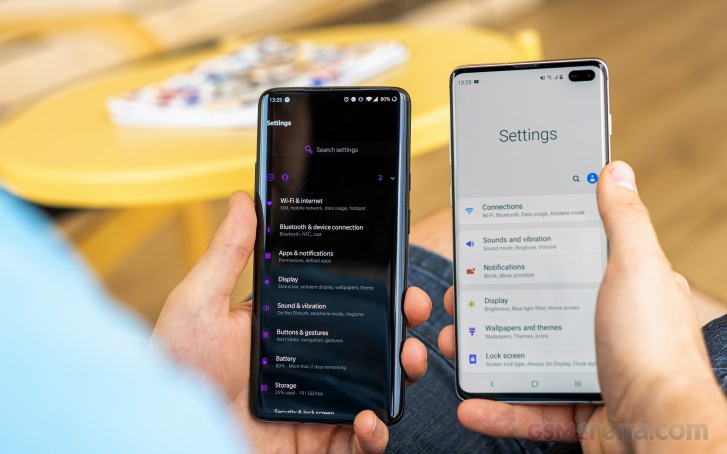
And last, but not least, One UI gives you more control over the battery usage. You've got several preset modes (a high-performance one included, which can be considered as OnePlus' Gaming Mode counterpart), toggle fast charging, put apps to sleep and prevent them from receiving notifications and updating and many more.
OnePlus' OxygenOS although pretty stripped, has its perks and some features that One UI doesn't. Take the screen-off gestures that launch a specific app (including the flashlight) or the notification slider key. Then double-tap on the home screen locks the phone - we could have used that feature on the S10+ with the high placement of the power button.
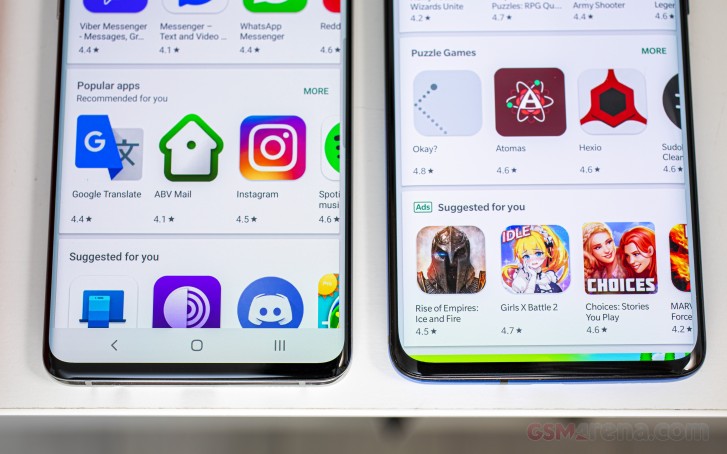
Navigation is where the OxygenOS stands out. OnePlus gives you the option to choose between Android Pie's default pill navigation, standard software buttons and OnePlus' in-house gestures. We really liked OnePlus' take on the gesture navigation and quick switching between apps is great. Sadly, there are some finger gymnastics involved with OnePlus' gestures due to the big screen and thin lip at the bottom. All gestures start from below the screen, and the learning curve is steep at first, but once you get used to it, OnePlus gestures reward you with animations which perfectly match your finger movement, offering a physical like interaction with the UI.
The lack of always-on screen functionality can be largely compensated by the ambient display. The phone is quite sensitive in this regard - a single light tap will show it (along with the illuminated fingerprint reader) and even a subtle movement will trigger it as well. You will always know where to place your finger on the screen.
The same cannot be said about the S10+. We've enabled the option for the screen to light up when you pick up the phone but it didn't always work and most of the times it turns on with a significant delay. The ambient display turns on only when you touch it once showing the clock and lighting up the fingerprint sensor area. Double tap once again lights up the whole screen. The good news, however, is that the fingerprint placement is quite natural. It didn't take long for us to hit the fingerprint reader spot consistently without hints, though.
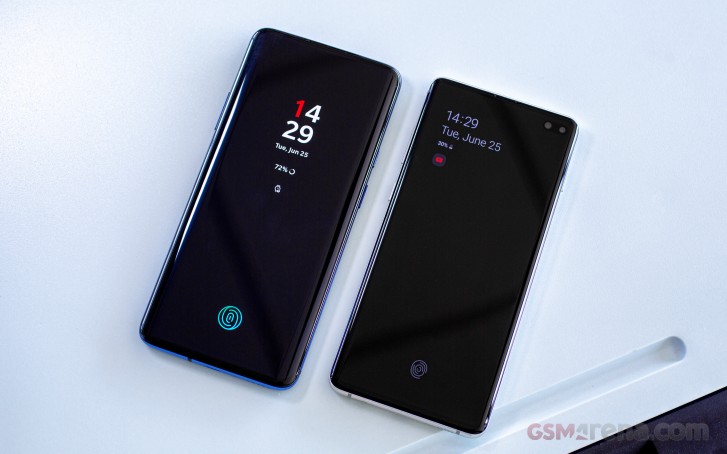
And while we are on the fingerprint subject, let's talk about usability. Since the devices use totally different under-display fingerprint technology, there's a learning curve to both. The Galaxy S10+'s ultrasonic scanner works better for wet or dirty fingerprints and isn't affected by strong direct sunlight. It also doesn't need for you to press your finger against the glass.
OnePlus' optical fingerprint reader, on the other hand, might have some trouble, although rarely, with unlocking under direct sunlight probably because the camera can't capture a clear image of your fingertip with all the surrounding light. And it works better when you press down your finger a little. We strongly recommend training the fingerprint reader on the 7 Pro in a pitch black room. It vastly improves the performance of the scanner.
And even with the said drawbacks, the OnePlus 7 Pro's in-display fingerprint reader is by far the fastest one we've used so far. There's a noticeable difference when comparing it to the S10+, for example. We found that both readers are evenly fast but the 7 Pro's screen lights up way faster even with S10+'s unlock animation disabled. The only real advantage of the ultrasonic fingerprint reader so far is that it doesn't need illuminate your fingertip. As soon as you get used to the fingerprint placement, you can unlock it without waiting for a hint.
With face unlock, things are pretty much a tie. Yes, we were surprised as well. Even though you have to wait for the 7 Pro's camera to pop-up, the S10+ is only marginally faster in this regard. Both face unlock implementations are fast and consistent but not as reliable as an advanced facial unlocking like the Mate 20 Pro's or the iPhone Xs's, for example.
And now let's talk about the subjective nature of the OxygenOS. OnePlus has stripped down some animations and tempered with the CPU governor in all the right places to make the system snappy and absurdly fast. Navigating through menus, opening apps and multitasking just feels faster, smoother and snappier in general compared to the One UI. And it has nothing to do with the 90Hz display. This is by far the strongest argument for the OxygenOS. But don't get us wrong, though, Samsung's One UI still flagship-grade fast - you won't feel any hangs, hiccups or slow-downs.
Winner: Tie. Software has always been a subjective matter and it all depends on what you are after. Stock Android enthusiasts or Android enthusiasts as a whole might want to go for the OnePlus 7 Pro due to its clean nature and also the company allows you to root and install other ROMs without voiding your warranty. On the other hand, we have Samsung's polished One UI with an overwhelming amount of features and customization. We strongly recommend checking out both of the reviews to get a better grasp of OxygenOS and One UI. It will help you decide.
Performance
If you are one of the regions where the Samsung lineup is powered by the Snapdragon 855, there's not much we can talk about here. Both handsets are rocking the latest and greatest from Qualcomm and will handle everything you throw at them.
However, the more widespread version of the Galaxy S10+ is the one with the in-house Exynos 9820 chipset. It features a slightly different architecture compare to its Snapdragon counterpart and that's why we have some a small difference in the benchmark tests.
For one, the Exynos 9820 has two large Mongoose M4 cores clocked at 2.73GHz and two Cortex-A75 cores clocked at 2.31GHz. Those two clusters are doing the heavy lifting while the 4x Cortex-A55 clocked at 1.95GHz take care of the not so demanding tasks. The Snapdragon 855, on the other hand, features 1x Kryo 485 core ticking at 2.84GHz, 3x Kryo 485 at 2.42GHz and 4x Kryo 485 running at 1.8GHz so it's only natural for the Exynos 9820 to take the lead in single-core performance. In multi-core scenarios, there's not much of a difference.
GPU-wise, the Snapdragon 855's Adreno 640 trades blows with Exynos 9820's Mali-G76 MP12 in various GPU-intensive benchmark tests so, in the end, you won't feel a difference here as well.
And as far as memory is concerned, keep in mind that the 7 Pro caps at 12GB of RAM and 256GB of internal storage while the Galaxy S10+ has 512GB and 1TB variants, with only the latter rocking 12GB of RAM whereas the former stays at 8GB. And the 7 Pro doesn't have microSD card slot as well so if internal storage is of great importance to you, the S10+ will most probably suit your needs better.
GeekBench 4.1 (multi-core)
Higher is better
- Apple iPhone XS Max
11432 - Xiaomi Mi 9
11181 - OnePlus 7 Pro
10943 - Asus Zenfone 6 (Zen Power Boost)
10800 - Asus Zenfone 6
10721 - Samsung Galaxy S10+
10387 - Huawei Mate 20 Pro (perf.)
10110 - Huawei P30 Pro (perf. mode)
10014 - Huawei Mate 20 Pro
9712 - Huawei P30 Pro
9649
GeekBench 4.1 (single-core)
Higher is better
- Apple iPhone XS Max
4777 - Samsung Galaxy S10+
4522 - Asus Zenfone 6
3505 - Xiaomi Mi 9
3503 - Asus Zenfone 6 (Zen Power Boost)
3499 - OnePlus 7 Pro
3402 - Huawei Mate 20 Pro (perf.)
3390 - Huawei P30 Pro (perf. mode)
3323 - Huawei Mate 20 Pro
3291 - Huawei P30 Pro
3270
AnTuTu 7
Higher is better
- Asus Zenfone 6 (Zen Power Boost)
377024 - Xiaomi Mi 9
372006 - OnePlus 7 Pro
364025 - Asus Zenfone 6
361679 - Apple iPhone XS Max
353210 - Samsung Galaxy S10+
333736 - Huawei P30 Pro (perf. mode)
316156 - Huawei Mate 20 Pro (perf.)
308050 - Huawei P30 Pro
290189 - Huawei Mate 20 Pro
273913
GFX 3.1 Manhattan (1080p offscreen)
Higher is better
- Apple iPhone XS Max
99 - Asus Zenfone 6
71 - Asus Zenfone 6 (Zen Power Boost)
71 - Xiaomi Mi 9
70 - Samsung Galaxy S10+
69 - OnePlus 7 Pro
68 - Huawei P30 Pro (perf. mode)
56 - Huawei Mate 20 Pro (perf.)
54 - Huawei P30 Pro
54 - Huawei Mate 20 Pro
53
GFX 3.1 Manhattan (onscreen)
Higher is better
- Apple iPhone XS Max
60 - Asus Zenfone 6
57 - Asus Zenfone 6 (Zen Power Boost)
57 - Xiaomi Mi 9
56 - Huawei P30 Pro
50 - Huawei P30 Pro (perf. mode)
50 - Samsung Galaxy S10+
37 - OnePlus 7 Pro
33 - Huawei Mate 20 Pro
27 - Huawei Mate 20 Pro (perf.)
27
GFX 3.1 Car scene (1080p offscreen)
Higher is better
- Apple iPhone XS Max
60 - Samsung Galaxy S10+
42 - Xiaomi Mi 9
42 - Asus Zenfone 6
42 - Asus Zenfone 6 (Zen Power Boost)
42 - OnePlus 7 Pro
41 - Huawei Mate 20 Pro (perf.)
33 - Huawei P30 Pro (perf. mode)
33 - Huawei Mate 20 Pro
29 - Huawei P30 Pro
29
GFX 3.1 Car scene (onscreen)
Higher is better
- Apple iPhone XS Max
47 - Asus Zenfone 6
36 - Asus Zenfone 6 (Zen Power Boost)
36 - Xiaomi Mi 9
35 - Huawei P30 Pro (perf. mode)
29 - Huawei P30 Pro
27 - Samsung Galaxy S10+
23 - OnePlus 7 Pro
19 - Huawei Mate 20 Pro
17 - Huawei Mate 20 Pro (perf.)
16
3DMark SSE 3.1 Unlimited
Higher is better
- Asus Zenfone 6 (Zen Power Boost)
6282 - Asus Zenfone 6
6263 - OnePlus 7 Pro
6093 - Xiaomi Mi 9
5816 - Samsung Galaxy S10+
4632 - Huawei P30 Pro (perf. mode)
4315 - Huawei P30 Pro
3522
Winner: Tie. Both devices come with capable high-end SoCs, no matter which version of the Galaxy S10+ you get. The smartphones will handle absolutely everything you throw at them with no hiccups.
Triple for all situations
Both phones have you covered in all situations. They have a normal, telephoto and an ultra wide-angle camera on their back making for a versatile experience. It's now a norm for modern flagships to feature at least three cameras covering all the bases.
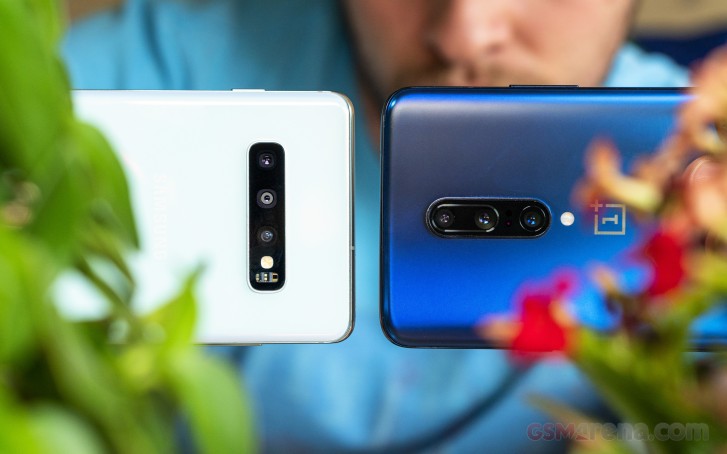
Lets start with the main cameras. The S10+ offers a 12MP unit with variable aperture ranging between f/1.5 to f/2.4 with large 1.4µm pixels and, of course, OIS. On the other side stands the 7 Pro's 48MP main sensor that has become increasingly popular for the last half year or so. It uses pixel binning technology that combines four adjacent pixels into one capturing 12MP still images with increased light sensitivity, better dynamic range and sharper detail. The aperture is f/1.6 and features OIS as well. It's also aided by a laser autofocus system for better performance in low light.
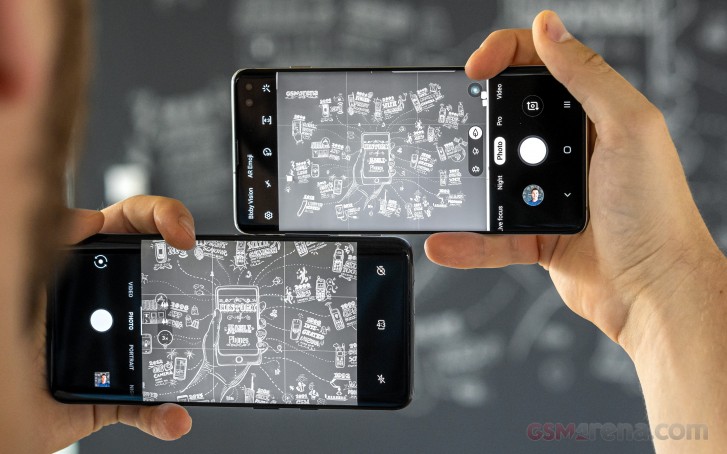
In the telephoto department, the 7 Pro wins with a 3x lossless zoom as opposed to the 2x optical zoom on the Galaxy S10+. It's important to note that the 7 Pro doesn't rely solely on optics. In reality, the sensor isn't 8MP as advertised but it's actually 13MP with around 2.2x optical zoom. The software then crops down another ~0.8x and the end result is an 8MP with 3x lossless zoom. The same telephoto sensor is used for making portraits but outputs the original 13MP with 2.2x magnification image.
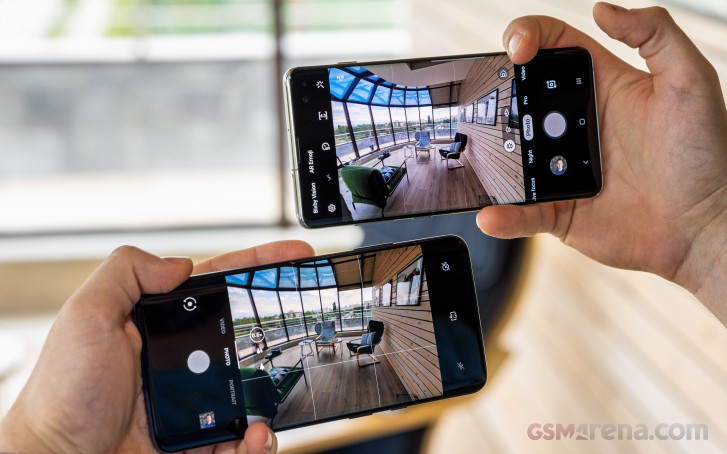
Samsung's 12MP telephoto camera does no such thing. It's has pure 2x optical zoom and it's also optically stabilized. It can also be used for portrait shots but you can also opt for the regular.
In the wide-angle department, both handsets sport 16MP snappers with f/2.2 but the S10+ takes the lead with a slightly wider field of view - 12mm vs 13mm. One millimeter may not sound much but it makes a difference and you will see it in the sample photos comparison.
And as far as selfie cams go, the 7 Pro has more detailed 16MP f/2.0 unit attached to the motorized unit while the S10+ has two snappers on the front - one 10MP with f/1.9 and one 8MP camera for depth sensing. This means that portrait selfies should turn out better. More importantly, though - the S10+'s front-facing camera has autofocus while the 7 Pro's 16MP unit lacks one. Oh, and only the S10+ can shoot 4K videos with its front camera.
Camera apps, interface and features
To be honest, there's not much of a difference UI-wise. Both camera apps change modes by swiping left and right. The S10+, however, accommodates all of its modes on swipe bar while the 7 Pro lets you choose and re-arrange which modes to appear. Swiping up from the bottom opens up the full list of available modes.
There are two things we need address here. The S10+'s app names the portrait mode as Live focus and when shooting selfies, the software crops the photos by default to 6.5MP so you have to tap every single time on the full-res, full coverage mode every time you attempt to do a selfie. This needs to be fixed with a future update.
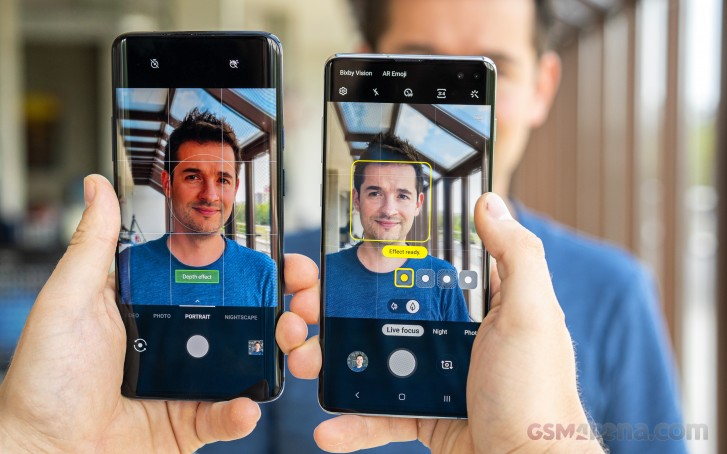
Samsung's scene optimizer appeared to be more informative and accurate than the Smart Content Detection on the 7 Pro. Both modes can be turned off, though.
In addition to the standard Pro modes, both camera apps allow you to manually control the HDR mode. When put to automatic, the apps will prompt you with a small icon indicating that HDR is active for the current scene.
And while everything seems unified and familiar to some extent, video recording is where the S10+ takes the lead. It not only offers super slo-mo 720p videos at 960fps but it can also produce action cam-like videos with 1080p resolution. The Super Steady shot uses the wide-angle lens, crops out most of the scene and you end up with perfectly stabilized 1920x1080 video. It works wonders.
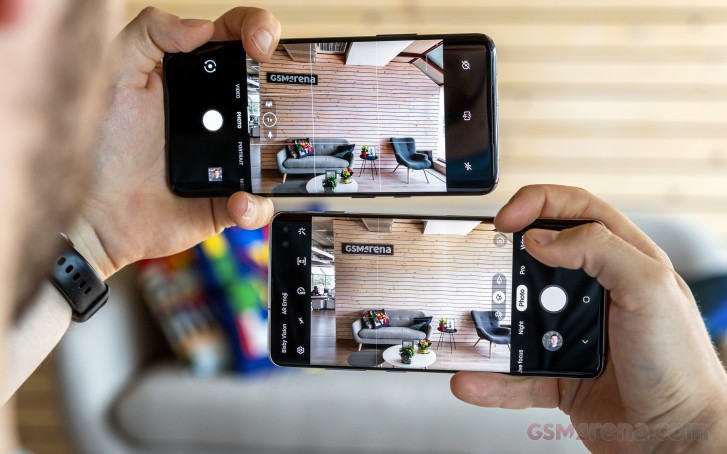
The 7 Pro, unfortunately, lacks any of those modes and caps the slow-motion recording to 720@480fps or 1080p@240fps.
Moreover, the 7 Pro can shoot videos using only its main and telephoto cams - no wide-angle video. The S10+ can do it with all three units on its back. And Night Scape (OnePlus' night mode) works only with the main camera while the S10+ can do night mode shots with its ultra-wide too.
Winner: The Galaxy S10+. Camera features-wise, the Galaxy S10+ is surely the more capable of the two thanks to its additional video modes and selfie camera with autofocus.
Daylight stills: Main camera
Using their main cameras, both phones take excellent photos. The end result is always good-looking 12MP images. Still, there are some notable difference between the two, which we would like to go through.
It's hard to tell why some of the 7 Pro's images appear a bit fuzzy at times but our best guess is because of the HDR image stacking. When HDR kicks in, and you don't shoot super still, some areas of the stacked photos may come out fuzzy on the 7 Pro. Keep in mind that the effect isn't as prominent on the screen of the phone and usually snapping a few shots with a steady hand take care of that.








Daylight main camera: OnePlus 7 Pro • Galaxy S10+
But regardless whether the 7 Pro images are tack sharp from edge to edge or not, the S10+ still has the better overall detail in most daylight photos.
Generally, the S10+'s photos look juicier with punchy colors but having taken the photos in person, the 7 Pro delivers more true to life colors. Samsung's offering gives you Instagram-ready or other social network-ready photos without filters.








Daylight main camera: OnePlus 7 Pro • Galaxy S10+
You might also notice that the S10+'s HDR algorithm is a tad better. It handles highlights and shadows a bit better by resolving more detail while keeping the image's exposure balanced across the board. Mind you, the 7 Pro also has an impressive dynamic range - it's just that in this direct battle, the Galaxy S10+ has the edge.








Daylight main camera: OnePlus 7 Pro • Galaxy S10+
Taking things to a macro level, you may notice that the 7 Pro's images are blurry as you move closer to the edge. That's because the main camera has a fixed f/1.6 aperture where the focus depth is narrower and thus can't fit all parts of the subject in focus. The Galaxy S10+, on the contrary, utilizes its variable aperture on the main unit quite well and if there's enough light, the software will opt for f/2.4 which provides a deeper focus depth or depth-of-field as it's technically known. If Samsung's camera resorted to using f/1.5, the DoF would be the same between the two.






Daylight main camera: OnePlus 7 Pro • Galaxy S10+
Daylight stills: Telephoto
Both devices have telephoto cameras which perform great - under the right conditions. In fact, we didn't see any noticeable differences between the S10+ and 7 Pro's telephoto stills in terms of quality. But we tend to favor the 7 Pro in this case as it offers a longer 3x zoom compared to the 2x zoom on the S10+. Of course, whether 3x trumps 2x is up for debate, but that's our call.








Daylight telephoto: OnePlus 7 Pro • Galaxy S10+
Daylight stills: Wide-angle
At first glance, both ultra wide-angle lenses produce similar images. The detail on both competitors is roughly the same - they trade blows from scene to scene. However, since the image resolutuion is the same, while the S10+'s wider field of view fits more of the scene in the frame, logic has it that on the per-pixel level the OnePlus 7 pro should have a more detailed shot. The S10+, however, resolves the same amount of detail while being wider - kudos to Samsung for that. We really wished the two handsets had autofocus on their wide-angle cams, though.






Daylight wide-angle: OnePlus 7 Pro • Galaxy S10+
Unfortunately, the downside of the S10+'s camera being wider is that image distortion is more prominent as well.






Daylight wide-angle: OnePlus 7 Pro • Galaxy S10+
Winner: The Galaxy S10+. Although they both produce excellent photos during the day and the 7 Pro has the better telephoto capabilities, the S10+ takes the cake with a more professional HDR implementation, generally better detail and as we saw with some of the macro samples, the variable aperture comes in handy. And it has a wider ultra wide-angle snapper without losing any detail in the process.
Low-light stills: Main camera
Nowadays it's hard to tell which flagship takes the best daylight photos and the competition has moved over to the low-light photography, and this is where we can easily say which one is the clear winner.








Low-light normal mode: OnePlus 7 Pro • Galaxy S10+








Low-light normal mode: OnePlus 7 Pro • Galaxy S10+
Once again, the Galaxy S10+ takes the lead with better detail across the board. Interestingly, exposure metering and dynamic range are almost identical. If you aren't looking close enough, it's hard to tell the difference between the two but, of course, upon closer inspection, the 7 Pro's images lack the level of detail the S10+ has. We also noticed that OnePlus' flagship handles neon signs and light sources better. You can easily read signs and lamps don't look splattered. The same cannot be said about the S10+.






Low-light normal mode: OnePlus 7 Pro • Galaxy S10+






Low-light normal mode: OnePlus 7 Pro • Galaxy S10+
Switching over to the Night modes, both phones benefit from them. They both gain detail and improve the rendering of detail in shadows and highlights.








Low-light night mode: OnePlus 7 Pro • Galaxy S10+








Low-light night mode: OnePlus 7 Pro • Galaxy S10+
Nevertheless, the same differences from the normal photo mode apply here as well - the S10+ resolves more detail in general. Dynamic range and exposure metering are on par with the 7 Pro and the latter still makes lights and neon signs look better.








Low-light night mode: OnePlus 7 Pro • Galaxy S10+
Low-light stills: Telephoto
If you plan on using the Galaxy S10+'s telephoto camera during the night, you will find it very difficult. More often than not, if the software detects that there's not enough light, it will default to the main camera and crop it from there. And surprisingly enough, it will be better than 7 Pro's telephoto performance at night. Even when cropped, the S10+ resolves more detail although slightly noisier. The 7 Pro's telephoto rendition aligns with the main camera's performance and lacks fine detail.






Low-light telephoto: OnePlus 7 Pro • Galaxy S10+
Low-light stills: Wide-angle
As all wide-angle cameras, these two struggle to deliver the desired nighttime performance - scene rendition is quite poor with details getting soft and fuzzy. Yet again, the S10+'s wide-angle camera during the night is somewhat better as it delivers more detail and the dynamic range isn't as bad. The 7 Pro's nighttime wide-angle shots are just fuzzy, to say the least.








Low-light wide-angle: OnePlus 7 Pro • Galaxy S10+
Winner: The Galaxy S10+. No matter which mode or camera you like to use, the S10+ is just better with resolving detail. In other aspects, both phones are quite comparable, but if you are looking to capture more detail in the dark, the Galaxy S10+ is the way to go.
Portraits
To be honest, we struggle to find any difference between the portraits shot with the telephoto cams on both handsets. Varying from scene to scene, images from both flagships are sufficiently detailed while edge detection, aside from some small inconsistencies, is excellent. The bokeh on the 7 Pro, though, is more prominent.




Portraits using the telephoto cams: OnePlus 7 Pro • Galaxy S10+
And if the light isn't sufficient, you should maybe use the main camera. If you can, of course, because the 7 Pro doesn't give you the option to choose between its main camera and the telephoto - the portrait mode is locked on the telephoto. So as you've probably guessed, low-light portraits on the S10+ are considerably better using the main camera.


Portraits with Galaxy S10+'s main camera
And a quick reminder - the 7 Pro uses the full 13MP resolution of the telephoto camera with around ~2.2x zoom instead of 8MP at 3x zoom like in the normal photo mode.
Selfies
Both handsets perform equally well and as one would expect, the 7 Pro tends to capture more detail with its 16MP front shooter. Interestingly, enough, this is only true with portrait selfies. We believe it's because of HDR. As we already established, when HDR kicks in, 7 Pro's photos lose a bit of detail along the way so the effect might be the same with the front-facing camera as well. Overall, despite the lower resolution of the S10+'s front-facing shooter, things look just about the same when it comes to fine detail.






Normal selfies: OnePlus 7 Pro • Galaxy S10+ • OnePlus 7 Pro • Galaxy S10+ • OnePlus 7 Pro • Galaxy S10+
We woulds still prefer S10+'s rendition, however, as it produces more natural color skin, the dynamic range is somewhat better and colors are juicier. It also has a slight edge over the 7 Pro's selfie portrait because of the secondary camera for depth sensing. Not saying the 7 Pro's software for faux bokeh isn't impressive on its own.






Portrait selfies: OnePlus 7 Pro • Galaxy S10+
Winner: The Galaxy S10+. Due to its flexibility with the normal and telephoto camera in portrait mode and better front-facing camera with autofocus, Samsung's flagship takes all the points in this category.
Video recording
Both smartphones are competent enough at taking videos but the Galaxy S10+ easily comes out on top with its plethora of shooting modes. The 7 Pro can only shoot with its main and telephoto cameras in 2160p at 30 and 60fps or 1080p at 30 and 60fps. Slo-mo videos cap at 720p@480fps and 1080p@240fps. In contrast, Samsung's competitor supports all those video modes in addition to Super Slo-mo 720p@960fps, normal videos using the ultra-wide lens and, of course, the so-called Super Steady shot. This one uses the ultra-wide angle to produce excellently stabilized video, almost action cam-like quality in 1080p resolution.
Anyway, we compared the two phones side by side in identical scenarios. We did the 2160p@30fps test on a tripod using the main cameras. It's clear that the Galaxy S10+'s video looks more pleasing because of the better contrast (this way colors pop out more) and superior sharpness. When it comes to dynamic range, both phones perform equally good.
We've also noticed the same effect with the aperture/depth of focus on the 7 Pro as we saw in the stills. Some of the subjects towards the edges of the scene lose detail while the variable aperture on the Galaxy S10+ adjusts so it ensures good uniformity across the whole scene.
We did a set of handheld videos again in 2160p@30fps but the test just confirmed what we've stated above.
In the telephoto department, the differences we've outlined become more prominent. The 7 Pro's telephoto video is just underwhelming, to say the least.
And here's how both devices deal with stabilization in 2160p@30 and 60fps. As you can see, there's no difference in the EIS on either of the competitors and stabilization is virtually non-existent in 60fps mode.
And here's a cool Super Slo-mo video shot on the Galaxy S10+ as a bonus.
Winner: The Galaxy S10+. Samsung completes the whole camera section with the last win in the video recording department due to its versatility and higher quality videos in general.
Wrap-up
Choosing a clear winner here would be tough as each has its strengths and weaknesses. But each to its own taste, right? We will try to summarize our findings in the process of doing the in-depth comparison.
No matter which one you choose, you will be greeted with superb build quality as only premium materials have been used. The curved front glass is a new thing for OnePlus, and it's a bit more subtle than the Galaxy S10+, and it improves the way you handle this humongous piece of tech. Although both roaming in the phablet territory, the OnePlus 7 Pro is definitely harder to handle, especially with one hand.
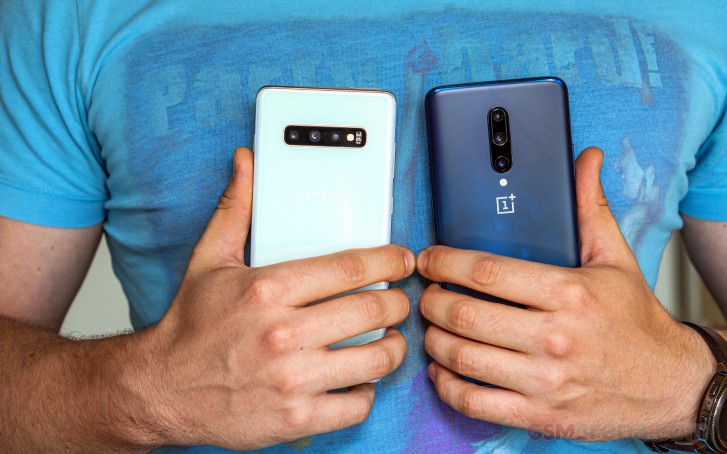
If proper ingress protection isn't all that important to you, the 7 Pro will do just fine in the rain or when briefly dropped in water. Otherwise, the Galaxy S10+ is the better solution. Aesthetically speaking, the 7 Pro gets bonus points for its true full-screen experience as long as you are comfortable with the periscope-like front-facing camera mechanism. Some may prefer the cutout on the S10+, though.
We would also like to touch on the multimedia capabilities. Here both phones are neck to neck. Sure, the S10+'s screen is a tad brighter, but the 7 Pro compensates with a larger display, more usable screen space and that sweet 90Hz refresh rate. And when it comes to loudspeaker quality, well, no complaints here on both ends.
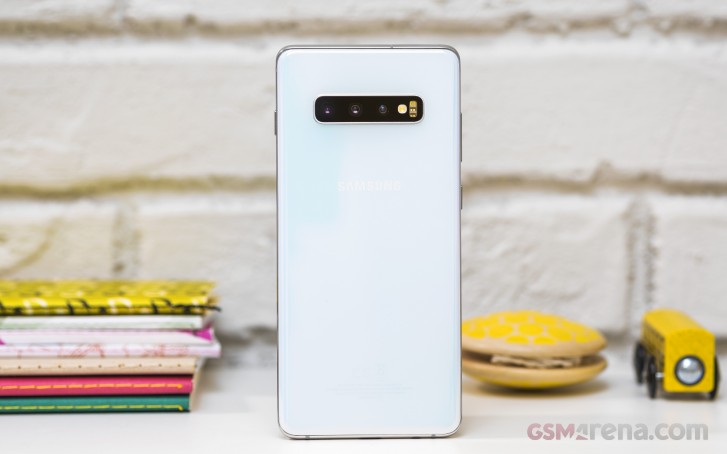
Your mileage may vary depending on your type of use, but you'd probably get similar battery life whichever handset you choose. It all boils down to how important fast charging and wireless charging are to you. If fast wired charging is your thing, the 7 Pro is the right choice, but if you are sick of tangled cables, the S10+ offers that freedom. Oh, and it can also charge your smartwatch on the go, which is kind of cool.
Camera quality is where both phones part ways. The Galaxy S10+ is the winner in this category and only if you are looking close enough on a PC monitor, for example. For social media posting, the OnePlus 7 Pro will do just as great. But if you like your photos sharper, especially during the night, the S10+ is the clear winner here. The same goes for video recording. There isn't much of a difference between the two in terms of quality, but the S10+ has more video modes and more advanced ones too.
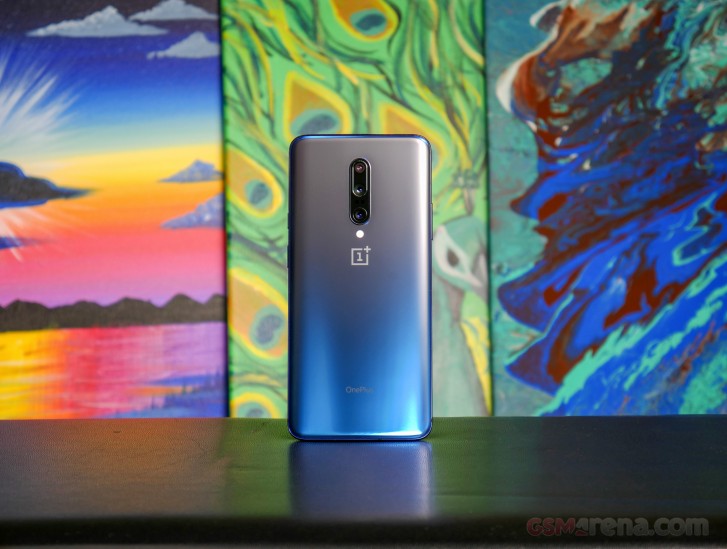
We will refrain from commenting any further on the software because it's strongly subjective. Our general recommendation - go for Samsung's One UI if you are looking for more advanced features and customizations or choose OnePlus' OxygenOS if speed is all that matters to you. Also, installing other ROMs and rooting won't void your warranty on the 7 Pro, which is a huge plus for Android enthusiasts.
When we started writing this piece, we thought we could give a definitive answer which big-screen flagship comes on top, but it turned out a lot harder than we initially anticipated. The Galaxy S10+ is closer to the "zero-compromise" flagship title having official IP68 ingress protection, microSD card support and 3.5mm audio jack but at what cost?
Despite the ever-increasing prices of OnePlus phones, the 7 Pro is still one of the more affordable high-end smartphones on the market. Currently, the starting price of the 7 Pro is about €100 less than the Galaxy S10+. The law of diminishing returns applies here as well. You've got to ask yourself - are you gaining all that much with the more expensive S10+ or the 7 Pro's feature set is enough to meet your needs. Then again, if you are not in a hurry, you could wait a few more weeks or a month or two and get the S10+ at an even lower price. The 7 Pro's price, on the other hand, will remain constant until the next model comes out this autumn. So as always, purchase timing and brand preference will be paramount for making this decision. The best thing is that you can't go wrong regardless which one you decide to get.

No comments:
Post a Comment