
Introduction
OnePlus' new lineup consists of its two flagship models: the OnePlus 9 and OnePlus 9 Pro. With these devices, OnePlus establishes a new position with competing OEMs as it snags the Hasselblad camera brand in a new partnership to help it further develop OnePlus' camera prowess. OnePlus is using the tagline "Your best shot", so let's see what all the fuss is about.


OnePlus 9 • OnePlus 9 Pro
You may be asking what exactly how Hasselblad was involved in the development of the OnePlus 9's cameras. As per OnePlus, Hasselblad has collaborated with the OEM to calibrate the cameras' sensors and tune the color optics to behave as they would on high-end Hasselblad cameras - known for their accurate colors and image output in 16-bit RAW. While the OnePlus 9 can't quite shoot in 16-bit RAW, it does have the ability to do so in 12-bit color while using the camera's Pro shooting mode.
In this review, we're going to focus on the [slightly] smaller of the two. The OnePlus 9 does skip out on some of the features that are exclusive to the 9 Pro - which has extra camera features, a more premium display, and support for OnePlus new 50W wireless charger. Storage is now updated to UFS 3.1 for faster read/write speeds, as well.
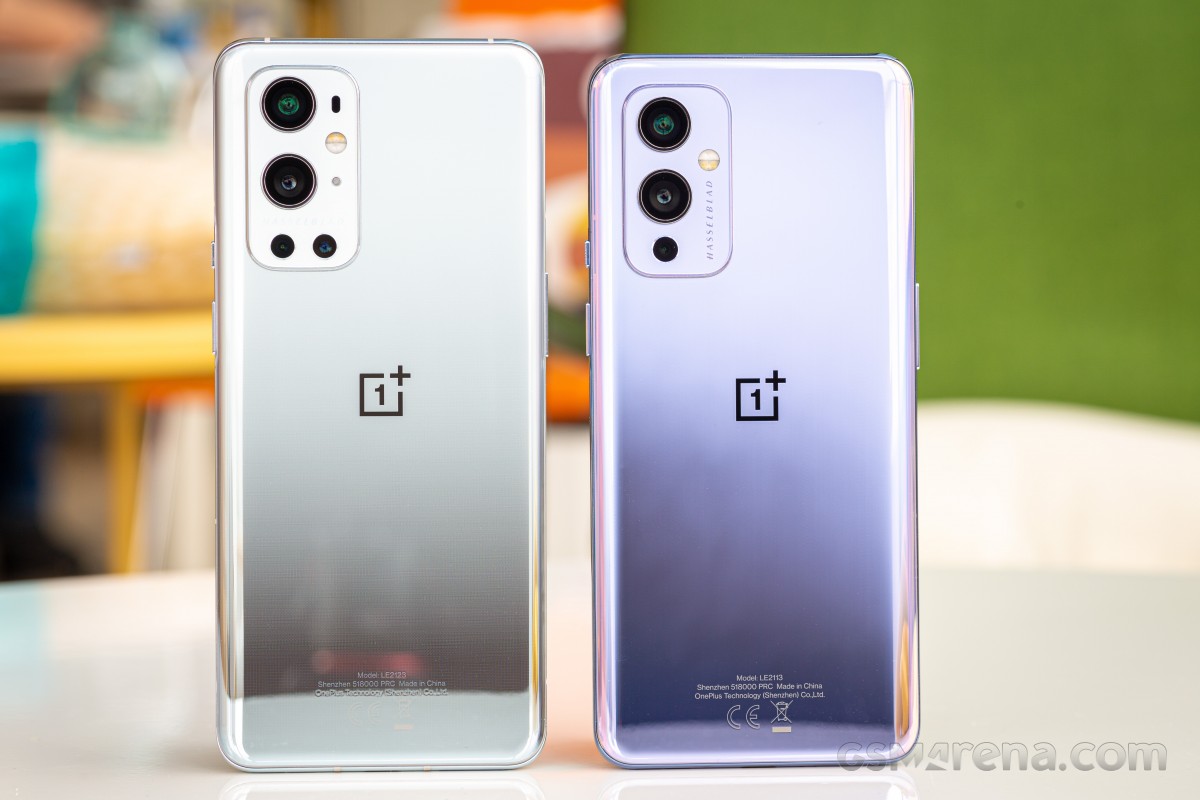
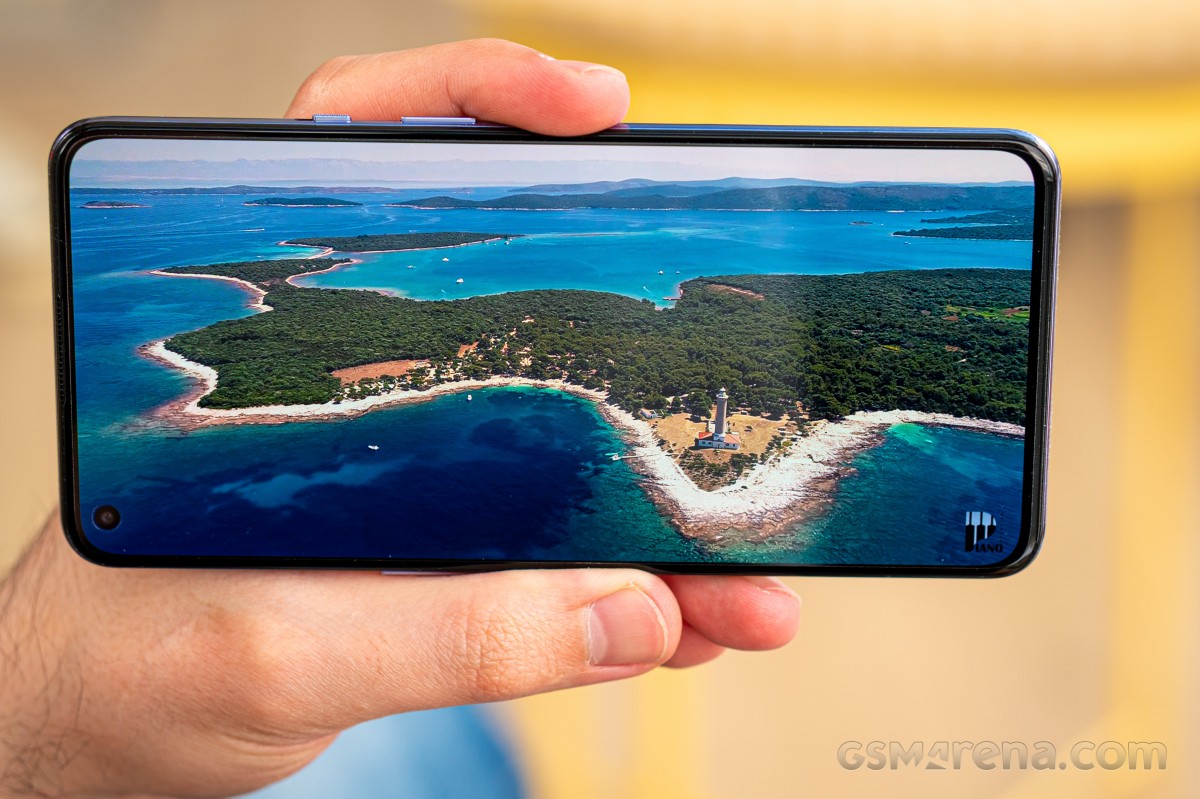
The look and feel of the OnePlus 9's design do not deviate far from its predecessor. The OnePlus 9 keeps the flat display and the new plastic frame could fool anyone into thinking it was metal. Don't worry though, the front and back panes are still made of Gorilla Glass. The punch-hole camera cutout remains in the same spot for now, and the main camera cluster gets a new arrangement.
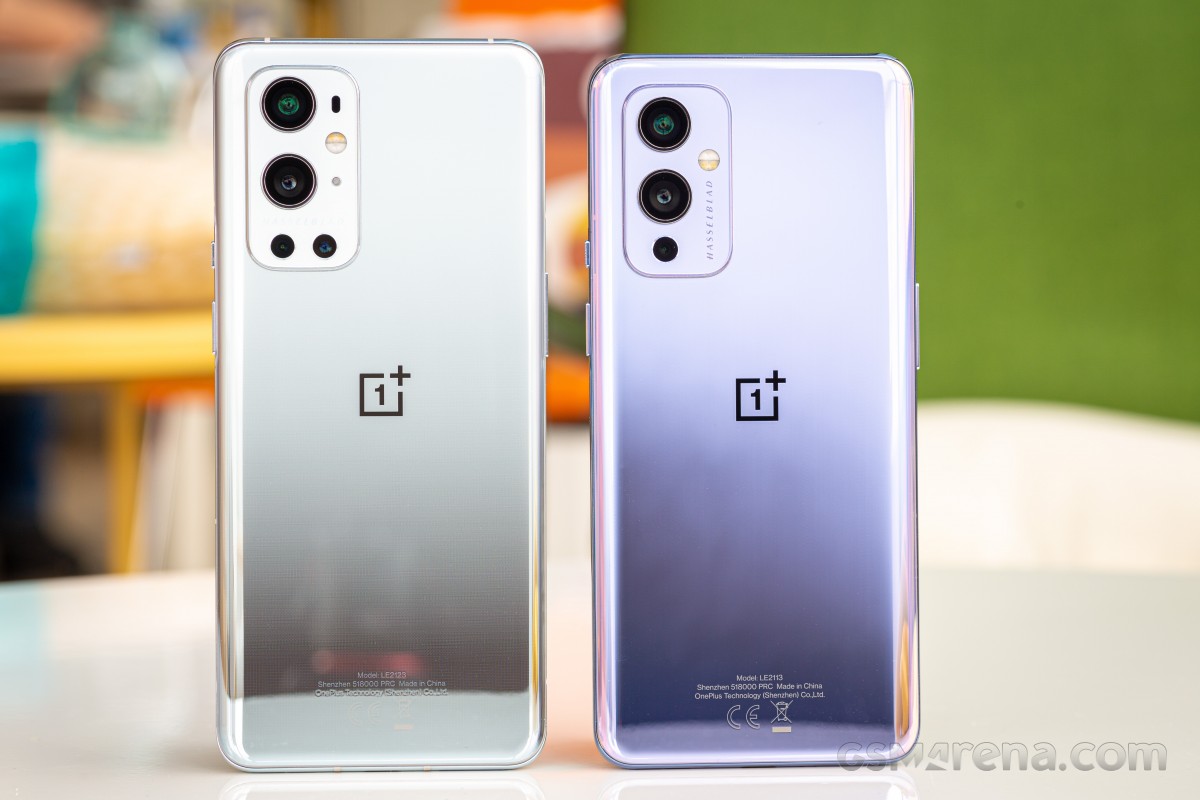 OnePlus 9 Pro next to OnePlus 9
Coming from the OnePlus 8, the 9 gets updated wired charging, updated camera modules, support for 120Hz refresh rate, and now supports bi-directional wireless charging, though only in select markets. The more obvious updates include the Snapdragon 888 5G Mobile Platform, and a bump in battery capacity.
OnePlus 9 specs at a glance:
- Body: 160.0x73.9x8.1mm, 183g; Glass front (Gorilla Glass), glass back (Gorilla Glass), plastic frame.
- Display: 6.55" Fluid AMOLED, 120Hz, HDR10+, 1100 nits (peak), 1080x2400px resolution, 20:9 aspect ratio, 402ppi; Always-on display.
- Chipset: Qualcomm SM8350 Snapdragon 888 (5 nm): Octa-core (1x2.84 GHz Kryo 680 & 3x2.42 GHz Kryo 680 & 4x1.80 GHz Kryo 680; Adreno 660.
- Memory: 128GB 8GB RAM, 256GB 12GB RAM; UFS 3.1.
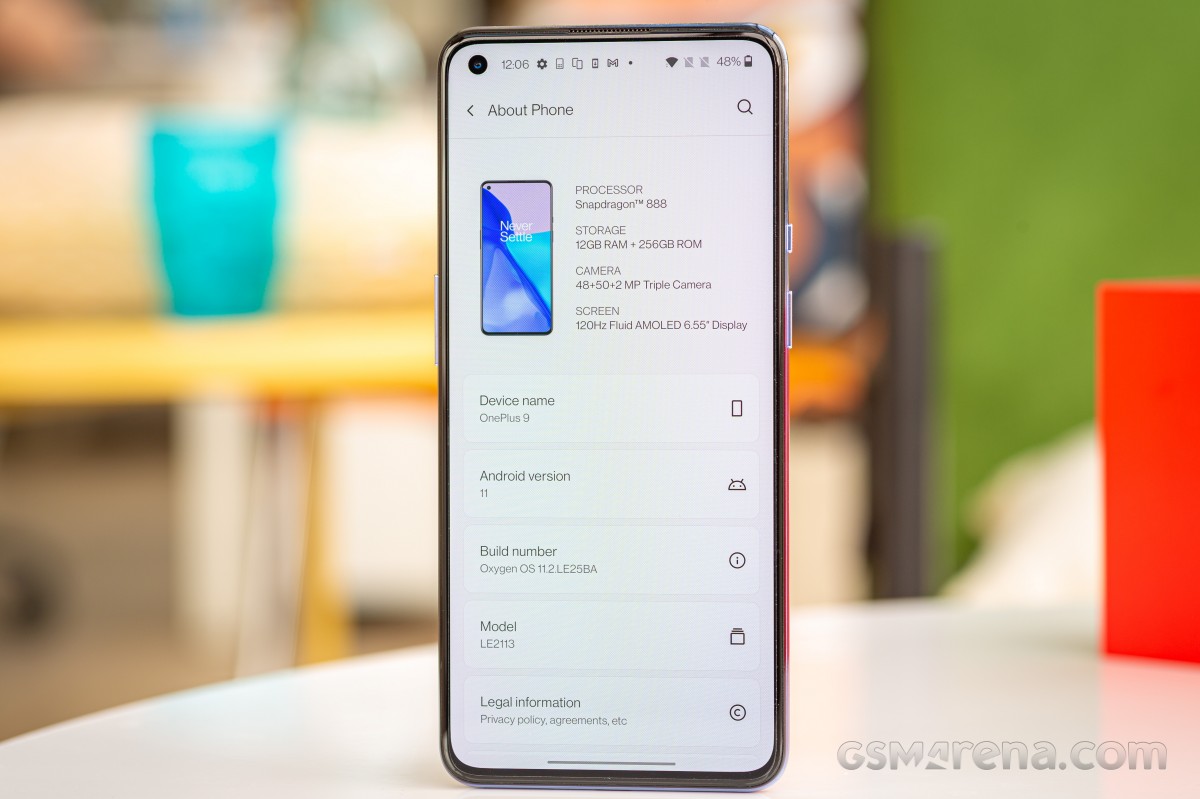
- OS/Software: Android 11, OxygenOS 11.
- Rear camera: Wide (main): 48 MP, f/1.8, 23mm, 1/1.43", 1.12µm, omnidirectional PDAF; Ultra wide angle: 50 MP, f/2.2, 14mm, 1/1.56", 1.0µm; Depth: 2 MP, f/2.4.
- Front camera: 16 MP, f/2.4, (wide), 1/3.06", 1.0µm.
- Video capture: Rear camera: 8K@30fps, 4K@30/60fps, 1080p@30/60/240fps, Auto HDR, gyro-EIS; Front camera: 1080p@30fps, gyro-EIS.
- Battery: 4500mAh; Fast charging 65W, 1-100% in 29 min (advertised), Fast wireless charging 15W (EU/NA only), USB Power Delivery.
- Misc: Fingerprint reader (under display, optical); NFC.
The OnePlus 9 now shares the same dual-cell battery setup that debuted on the OnePlus 8T. This means that the 9 supports OnePlus' Warp Charge 65T. This tech quickly charges two smaller batteries that work in tandem and a full charge of the batteries' combined 4,500 mAh capacity is promised in about half an hour.
The camera module has been updated to the Sony IMX689 - the same sensor from the OnePlus 8 Pro. The difference here is that this one is tuned with Hasselblad's likeness. The ultrawide module is a significant upgrade. This is a large 50MP sensor that beefs up the performance of the ultrawide camera in low-light photography and when shooting video. It also has a fancy new lens that drastically minimizes distortion normally observed on ultrawide cameras - we're excited to test it out.
Let's dig into the OnePlus 9 and see what experience the entry-level OnePlus flagship has to offer. Let's start with the contents of the phone's packaging.
Unboxing
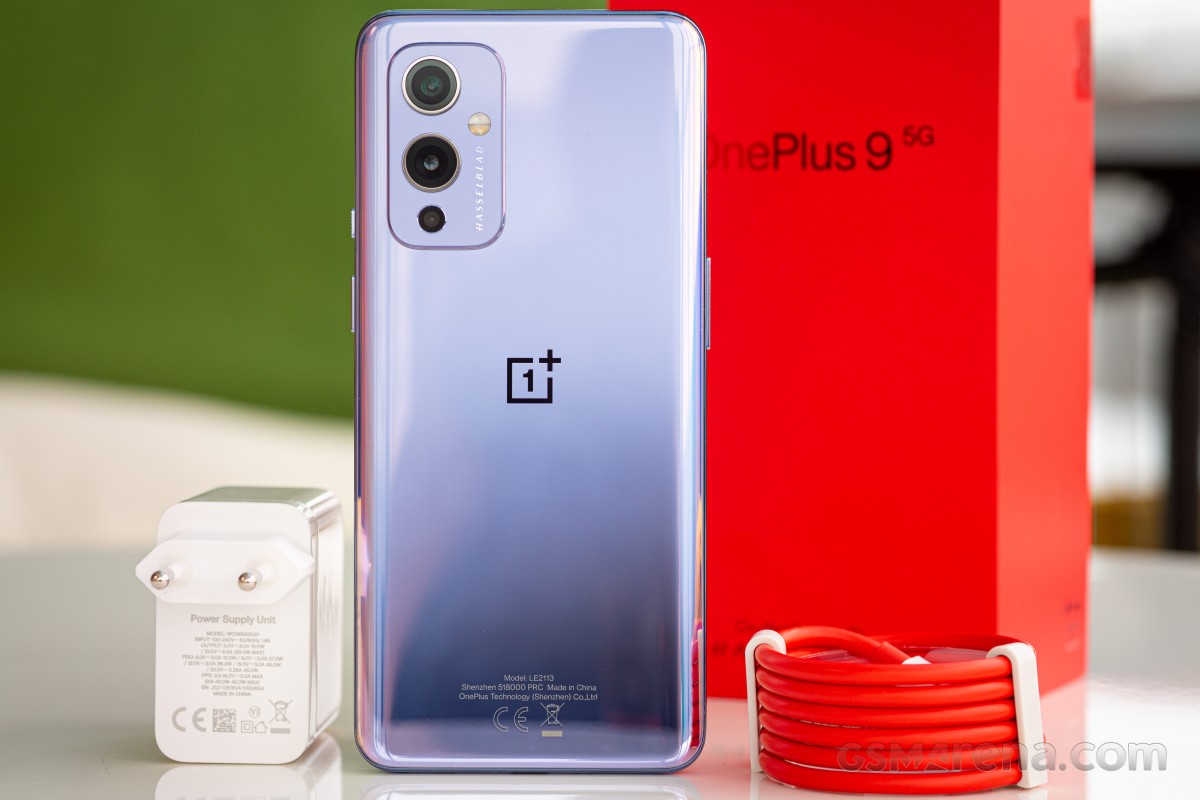
The OnePlus packaging has become a standard fare and the OnePlus 9 is no exception. Inside the now familiar red box is the phone at the top layer, followed by some paperwork, a silicone case in some markets, the 65W Warp Charge power adapter, and the usual red Type-C to Type-C USB 2.0 cable.
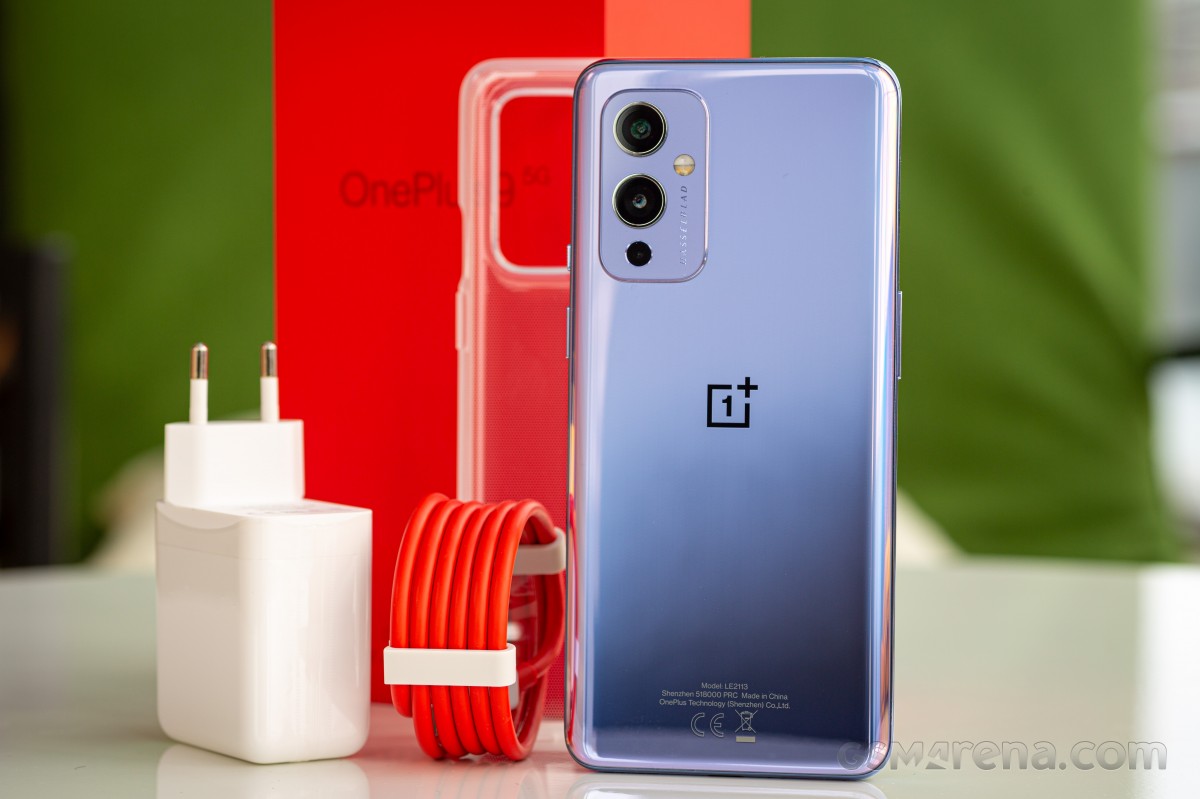
Unlike the opaque silicone case that comes with the 9 Pro, the OnePlus 8 silicone case is clear. We're not sure why OnePlus chooses to omit this accessory in some markets and decides to leave it elsewhere. There will be aftermarket cases, obviously, along with some first-party options from OnePlus.
As usual, there are no audio accessories inside the package. Not even an audio adapter.
Design and build quality
To say that the OnePlus 9 design is familiar would be an understatement. For the most part, the OnePlus 9 shares its design with the OnePlus 8T with the major visual difference being the redesigned camera module on the back. It reminds us of the OnePlus 7, which too had a hand-me-down design from its immediate predecessor, the OnePlus 6T.
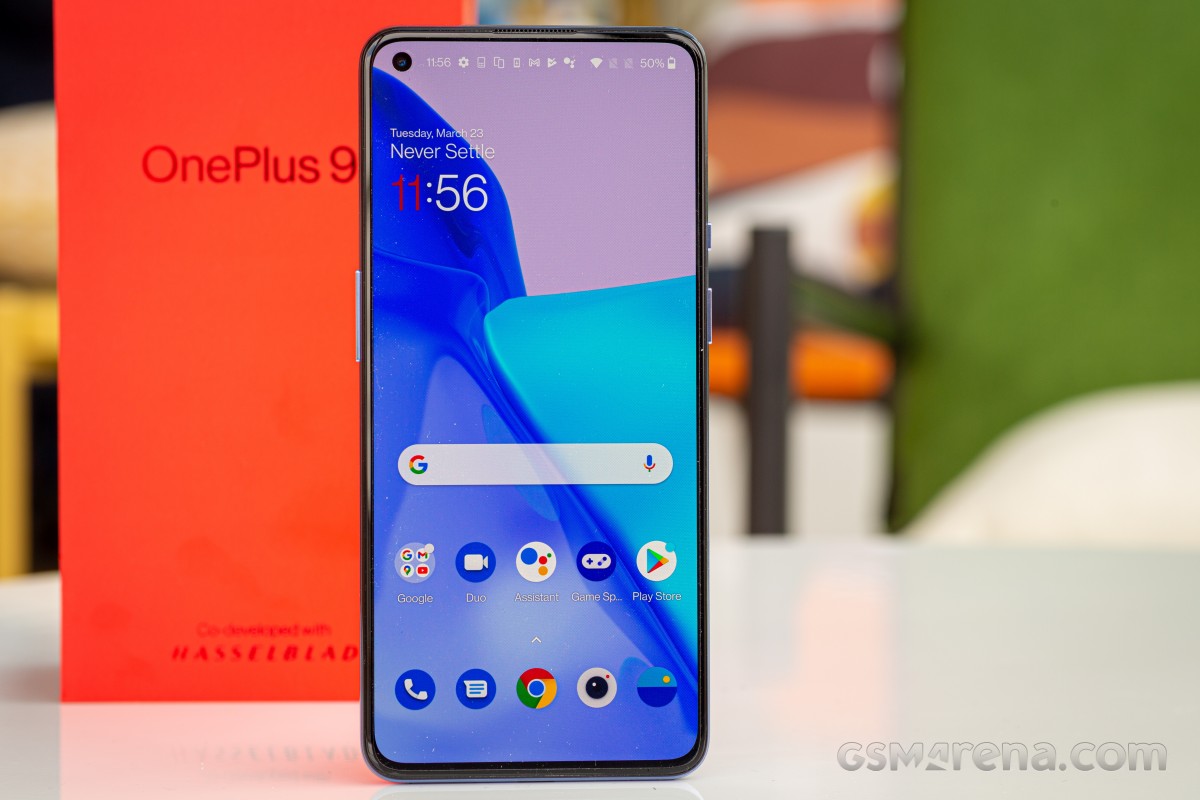
The front of the OnePlus 9 looks the same as that of the OnePlus 8T, which makes sense as both phones have the same display. This means it also has the flat glass on the front, which most people seem to prefer, and the hole-punch camera in the corner, which usually produces a mixed response.
Along the sides is where the OnePlus 9 differs the most from the OnePlus 8T. While the 8T has an aluminum frame, the OnePlus 9 uses fiber-reinforced plastic. Visually, it looks quite convincing, and even when you hold the device it's not immediately apparent that this isn't metal. As an upside, you also don't get the unsightly antenna lines found on aluminum frames. However, some people prefer their flagship devices to have flagship materials and if you fall in that category this plastic design might not appeal to you. Still, we'd urge you to at least try the device out first before making a judgment as it does look quite good in person.
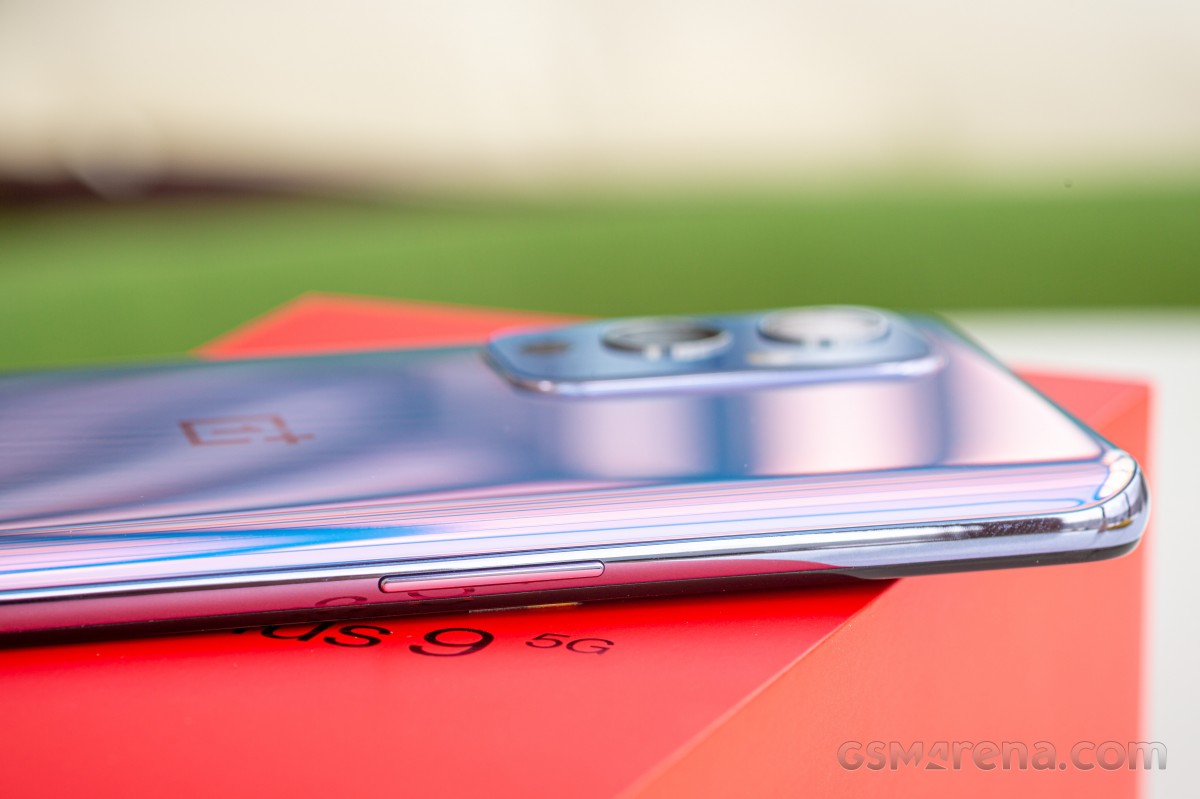
The OnePlus 9 has the same assortment of buttons and ports on the side as the 8T. However, like the OnePlus 9 Pro, the OnePlus 9 has its volume buttons shifted further down the left side, making it easier to access.
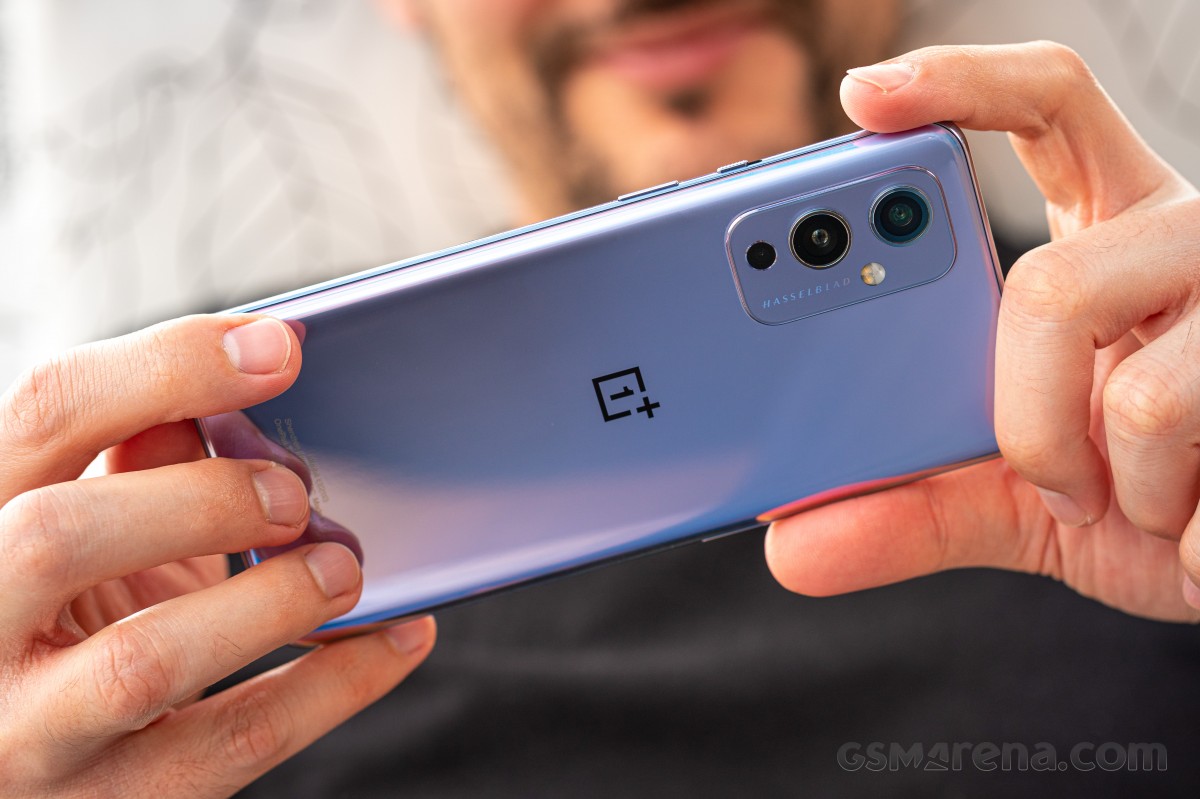
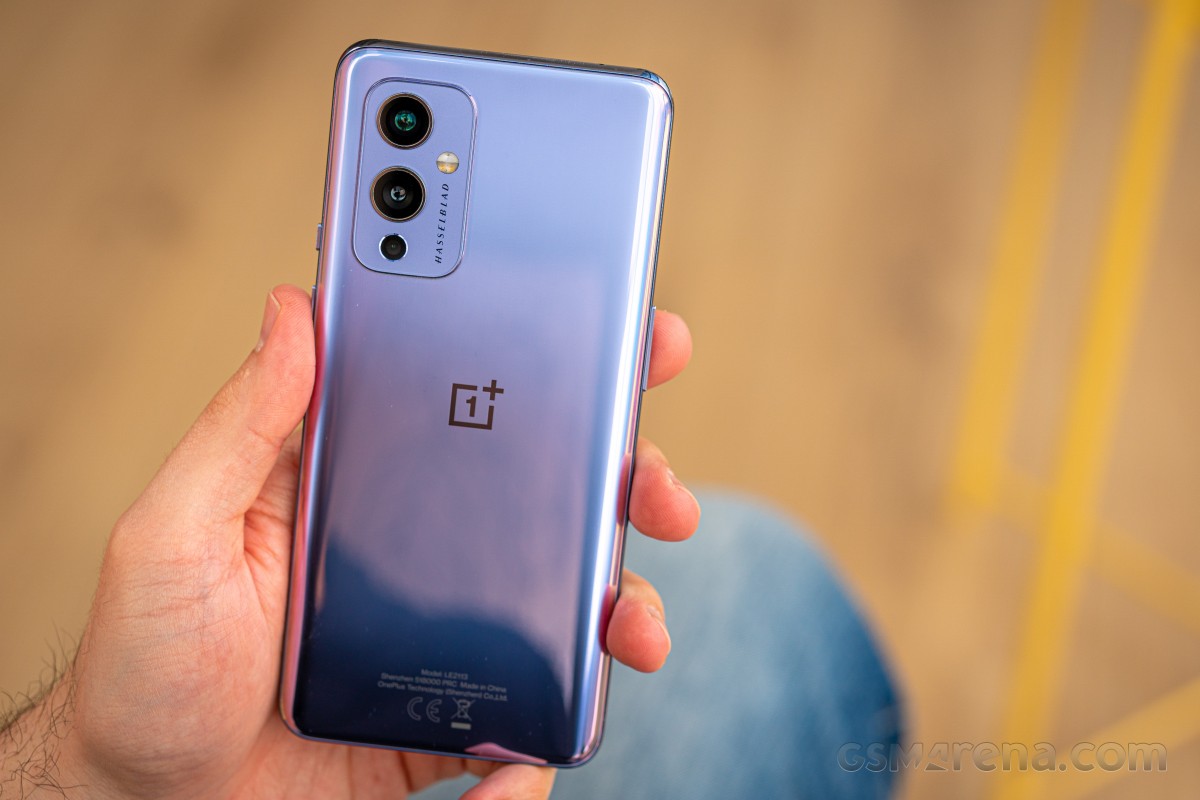
The back of the phone has a redesigned camera system in the corner. It's simplified and less busy looking compared to the design on the 8T, with a triple camera array and a reflective Hasselblad logo that glints in the light.
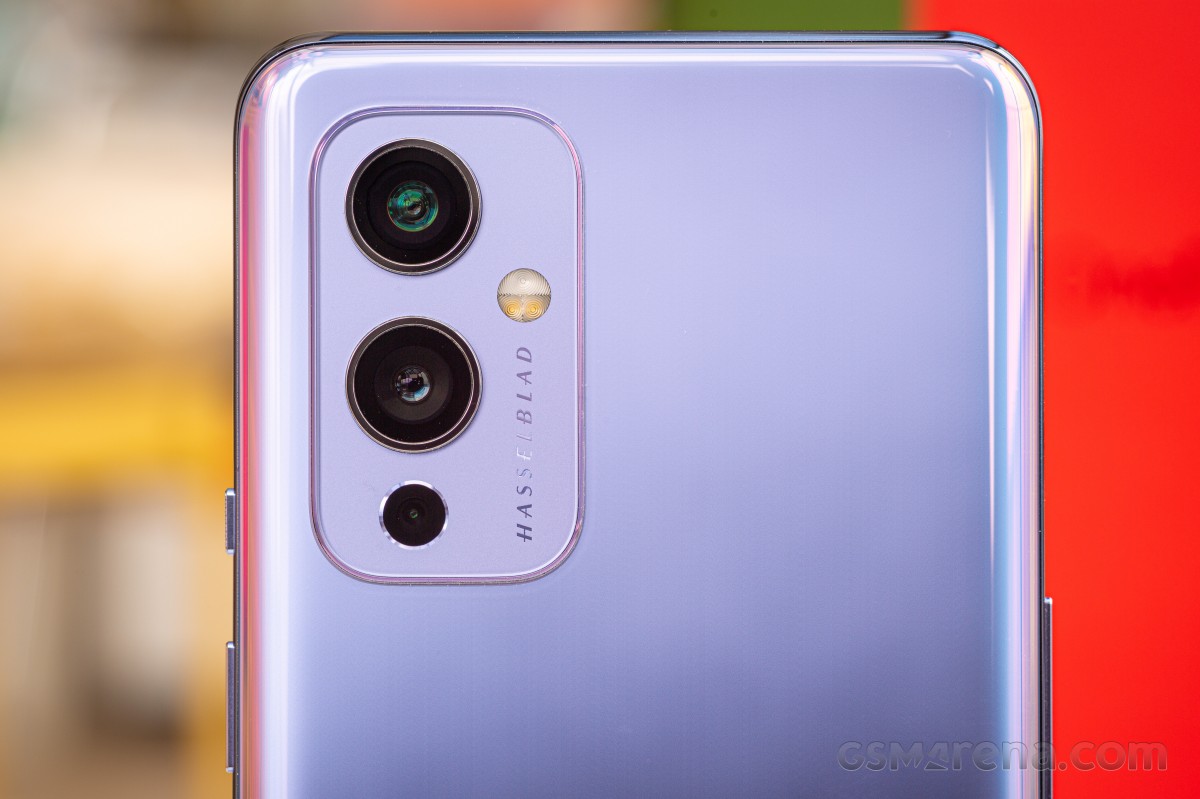
The back of the phone is still glass. It comes in three colors and two finishes. Our review unit came in Winter Mist, which has shades of violet and a glossy finish that gets progressively more reflective as you go down the back of the phone. The Arctic Sky color has a monotone blue with a matte finish while the Astral Black matte black film underneath a glossy glass that is said to reduce fingerprints. In each case, the camera module matches the color and finish of the rest of the back.
As with the OnePlus 8T and the OnePlus 8 before it, OnePlus has left out the ingress protection rating on the OnePlus 9. This isn't to say that the device hasn't been secured; we noticed the usual gasket around the SIM tray. This and a few other measures should allow the device to have some level of protection against water and dust. It's just not enough to get the IP68 rating that the OnePlus 9 Pro has. Also, it's worth noting that OnePlus is sticking with Gorilla Glass 5 for both the front and back of the phone, so you're also not getting the latest in shatter resistance.
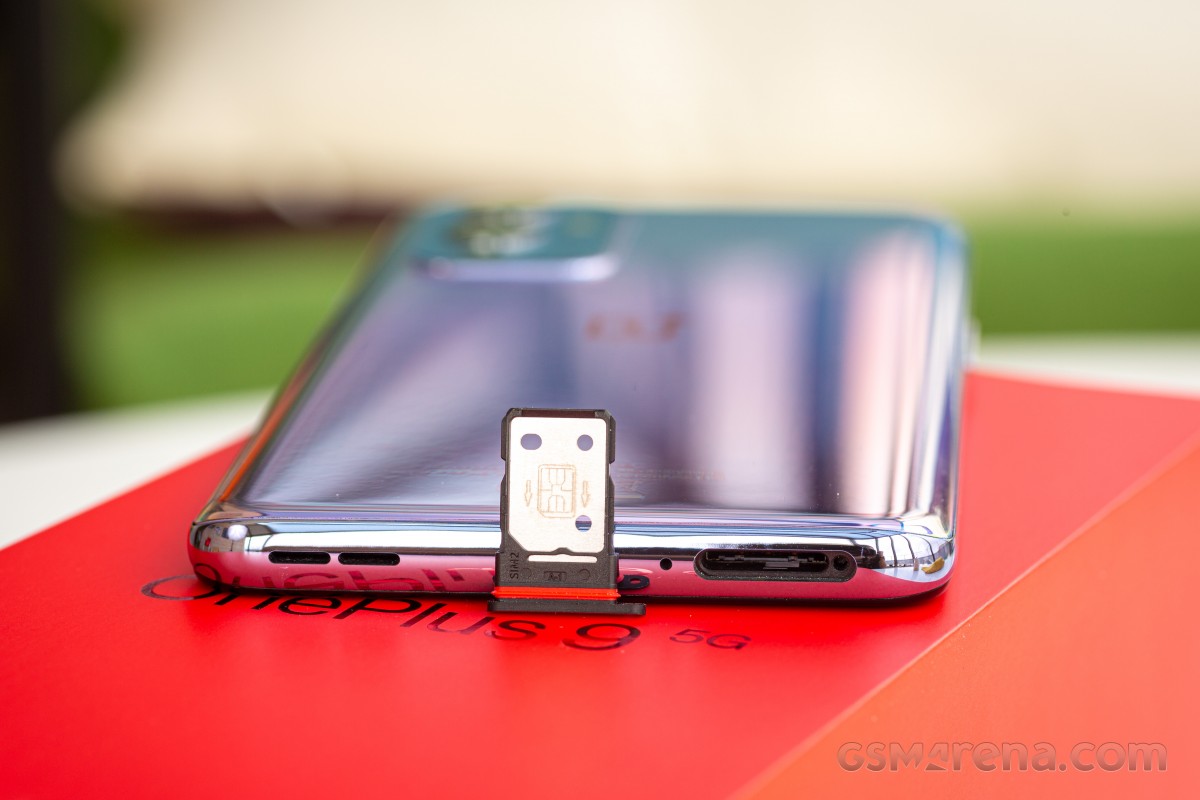
All in all, the design side of things is pretty underwhelming on the OnePlus 9 and we see OnePlus continuing to focus more on the Pro model. While the 9 Pro isn't particularly exciting itself, the recycled design, plastic frame, and lack of ingress protection on the OnePlus 9 may all be a step too far for product segmentation.
Display
The OnePlus 9 has a 6.55-inch, 2400x1800 resolution, 8-bit AMOLED display. The display has a 120Hz variable refresh rate and is capable of displaying HDR content. All of these specs are identical to the OnePlus 8T since it's using the same display.
| Display test | 100% brightness | ||
| Black, |
White, |
||
| 0 | 1023 | ∞ | |
| 0 | 926 | ∞ | |
| 0 | 888 | ∞ | |
| 0 | 883 | ∞ | |
| 0.038 | 871 | 22921:1 | |
| 0 | 822 | ∞ | |
| 0 | 821 | ∞ | |
| 0 | 815 | ∞ | |
| 0 | 807 | ∞ | |
| 0 | 803 | ∞ | |
| 0 | 802 | ∞ | |
| 0 | 774 | ∞ | |
| 0 | 639 | ∞ | |
| 0 | 538 | ∞ | |
| 0 | 525 | ∞ | |
| 0 | 518 | ∞ | |
| 0 | 498 | ∞ | |
| 0 | 496 | ∞ | |
| 0 | 493 | ∞ | |
| 0 | 485 | ∞ | |
| 0 | 459 | ∞ | |
| 0 | 458 | ∞ | |
| 0 | 450 | ∞ | |
In color performance, the OnePlus 9 display performed exceptionally well, with an average deltaE 2000 figure of around 1.7 in both sRGB and Display-P3 testing. The display can also achieve near 100% coverage of both spectrums. OnePlus provides a manual toggle in the settings to switch between the more accurate sRGB (Natural) mode or the more vivid Display-P3 (Vivid) mode. While the choice is entirely up to you, we think the Natural mode is the way to go as the device can automatically switch to P3 in applications that support it thanks to built-in color management in Android.
Like the OnePlus 9 Pro, the OnePlus 9 supports refresh rates up to 120Hz and can ramp down to lower values to save power. However, since this isn't an LTPO display, it can't go down to the claimed 1Hz that the OnePlus 9 Pro display supposedly can.
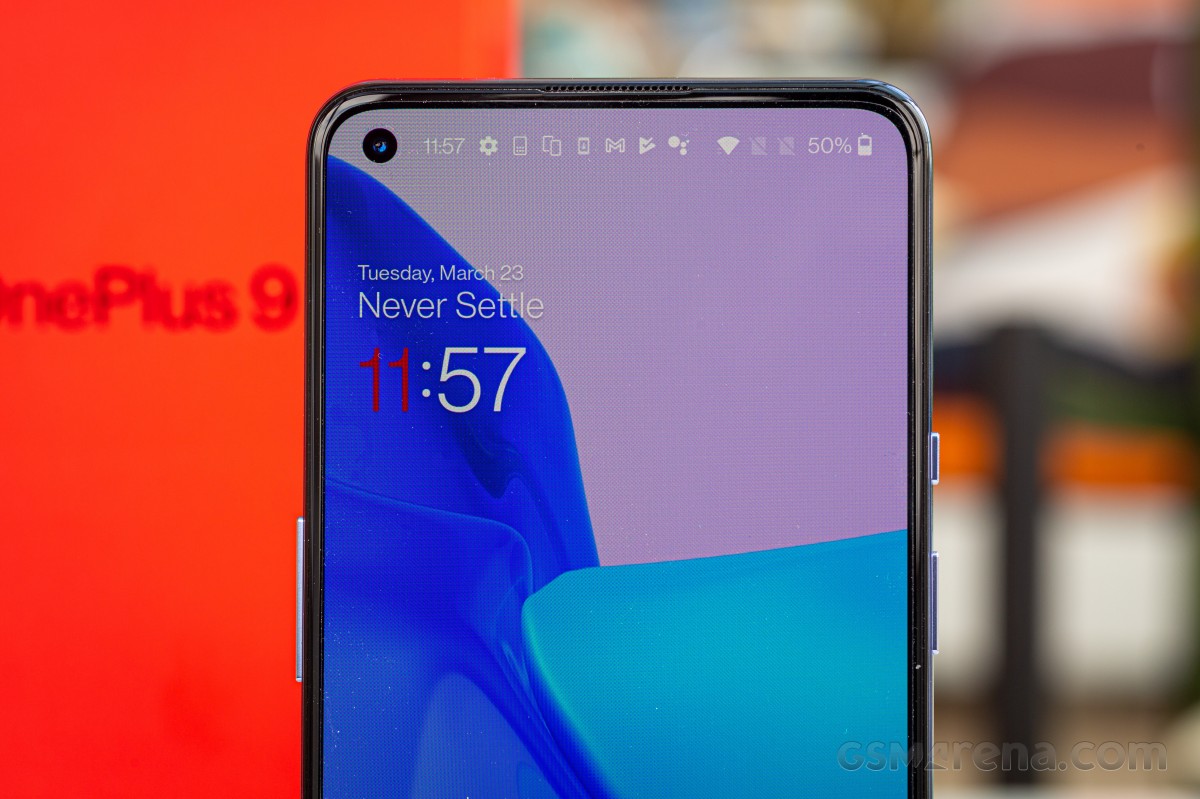
The default behavior for the display while interacting with it is to refresh at 120Hz. When the user stops interacting, the refresh rate drops down to a lower value of 60Hz for brightness values above 50% and 90Hz for brightness values below 50%. On top of that, certain apps and activities can cause the display to lock itself to 60Hz. This includes apps like Camera, Google Maps, etc., activities such as watching a fullscreen video and playing most games. The display will also drop the refresh rate of the app from 120Hz to 60Hz if the app has an embedded map or camera view for that particular screen.
As with the OnePlus 9 Pro, we would have liked to see the OnePlus 9 display support more intermediate values apart from 120Hz, 90Hz, and 60Hz. A 24/48Hz mode for watching 24fps content would have been great.
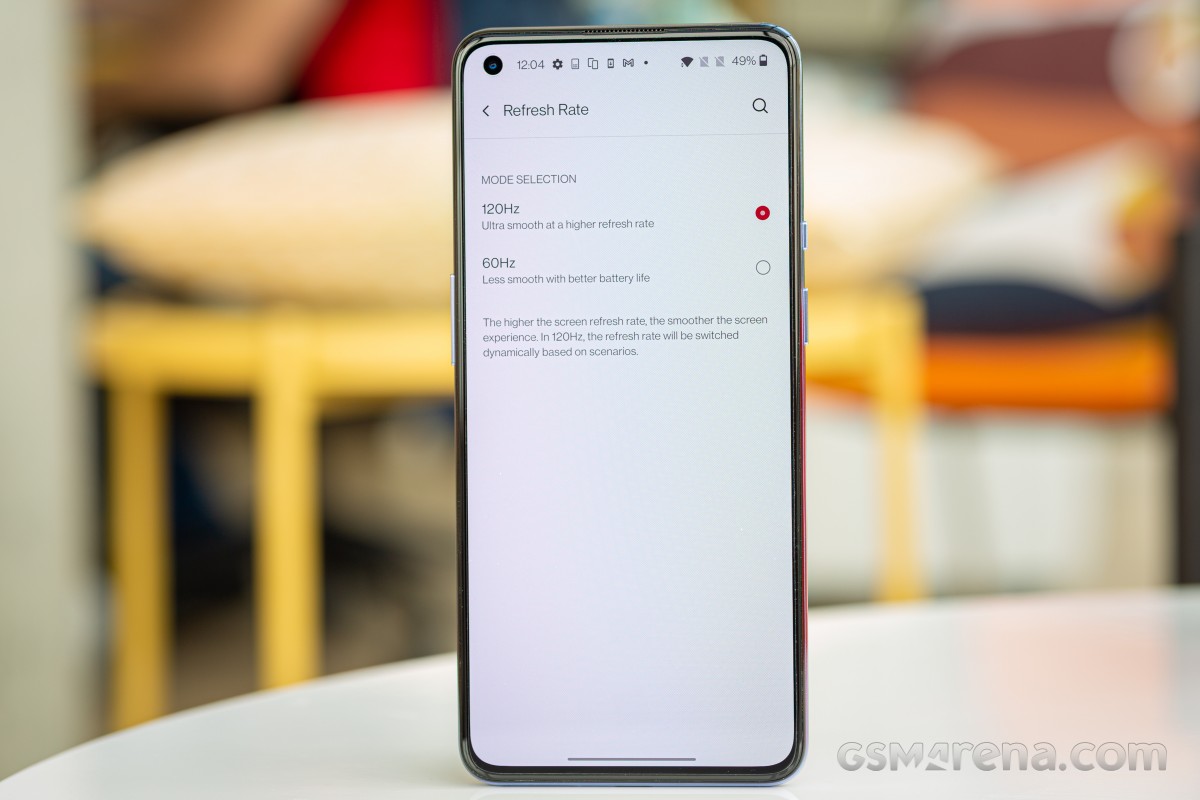
Perhaps more frustrating is OnePlus' continued lack of support for high refresh rate gaming. The company has whitelisted a very small number of games, such as Fortnite, PUBG Mobile, Pokemon Go, etc., and these are the only titles allowed to run at a maximum of 90Hz. This leaves a vast majority of games unsupported and there are also no titles that run above 90Hz. Moreover, OnePlus will also drop down the refresh rate of the display from 90Hz to 60Hz in supported games when the player stops interacting, which causes a jarring drop in fluidity because, unlike static UI screens, games tend to have moving elements on-screen animating at the display's refresh rate.
Like the OnePlus 9 Pro and the OnePlus 8 Pro, the OnePlus 9 has the Vibrant Color Effect Pro mode, which is intended to make videos appear more saturated. However, as with the OnePlus 9 Pro, the feature seems to do absolutely nothing on the OnePlus 9. On the OnePlus 8 Pro, enabling it would make all supported video apps appear strongly saturated. On the OnePlus 9, none of the apps we tried had any difference at all when the feature was enabled. We had first observed this on the OnePlus 8T and we are not quite sure what purpose this feature serves anymore.
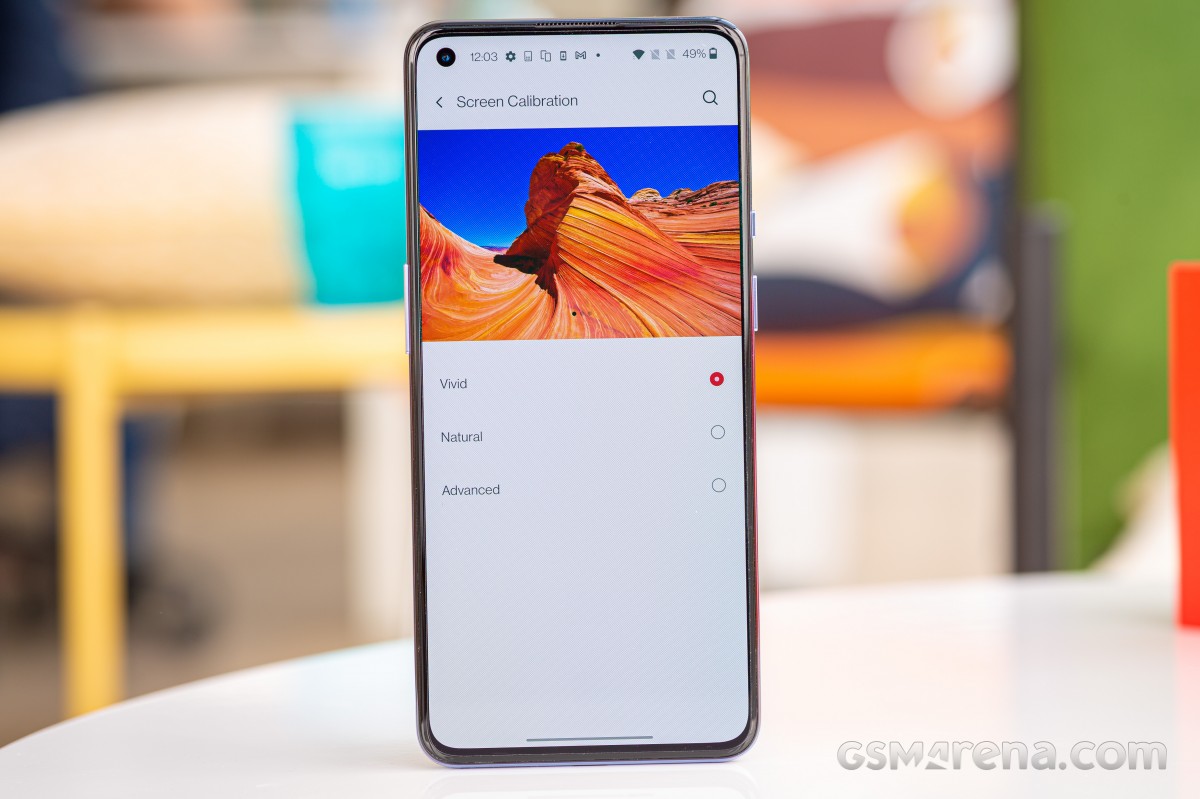
There's also a new Ultra-high video resolution mode, which at the time of testing was only available for Instagram. This feature uses AI to add edge enhancement to videos within supported apps. Videos on Instagram had more pronounced detail but it does tend to look a bit artificial.
The OnePlus 9 does not support Hyper Touch and Motion graphics smoothing modes, which is fine as the former does not make much of a difference and the latter actively makes things look worse.
The OnePlus 9 has good HDR performance. While watching HDR10 content on YouTube and Netflix apps, we observed impressive peak brightness and vibrant colors. The display on the OnePlus 9 is only 8-bit, which doesn't quite allow the 10-bit colors in native HDR content to come through quite well but in most content this isn't easily noticeable, especially considering the small size of the display.
The OnePlus 9 display also has some glow when displaying blacks. This means, if the screen is meant to be perfectly black while playing back HDR content, the screen will appear like it's still on and displaying a dark shade of gray rather than be completely off. It's not clear what causes this and why it's only limited to the HDR mode but it's not something to worry about as it's only visible in a pitch dark room while watching content with a lot of deep blacks in it.
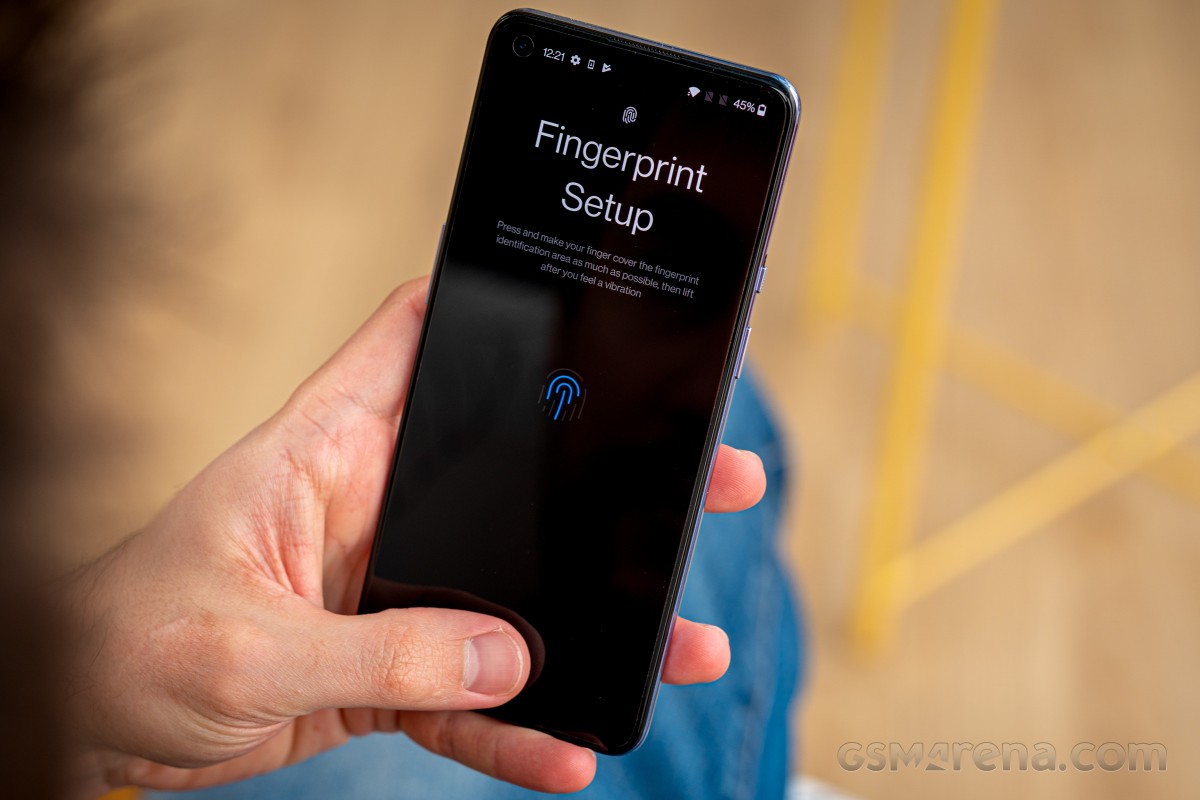
The display includes an optical fingerprint sensor. The fingerprint sensor on the OnePlus 9 is located unusually low, wherein it's only a few pixels above the navigation bar at the bottom. For those using gesture navigation, this may not be an issue but for those of us still sticking to the traditional way of navigating the UI, the fingerprint sensor on the OnePlus 9 is dangerously close to the Home button. Having said that, we are yet to accidentally press the Home button while accessing the sensor.
As for the sensor performance, it's mostly fine. If you use the same finger every time to unlock then it will work without any hassles and almost instantly. However, OnePlus phones do tend to get bamboozled if you switch your fingers every once in a while, even if the other finger is also registered. But that's an issue that only crops up after you've used the phones for a while and not something that usually shows up during the review period.
Battery Life
The OnePlus 9 uses dual 2,250 mAh cells that equate to a total battery capacity of 4,500 mAh: roughly the same capacity as the OnePlus 8T. Despite the Qualcomm Snapdragon 888 platform's advertised boost in efficiency, the OnePlus 9's battery performance was only average.
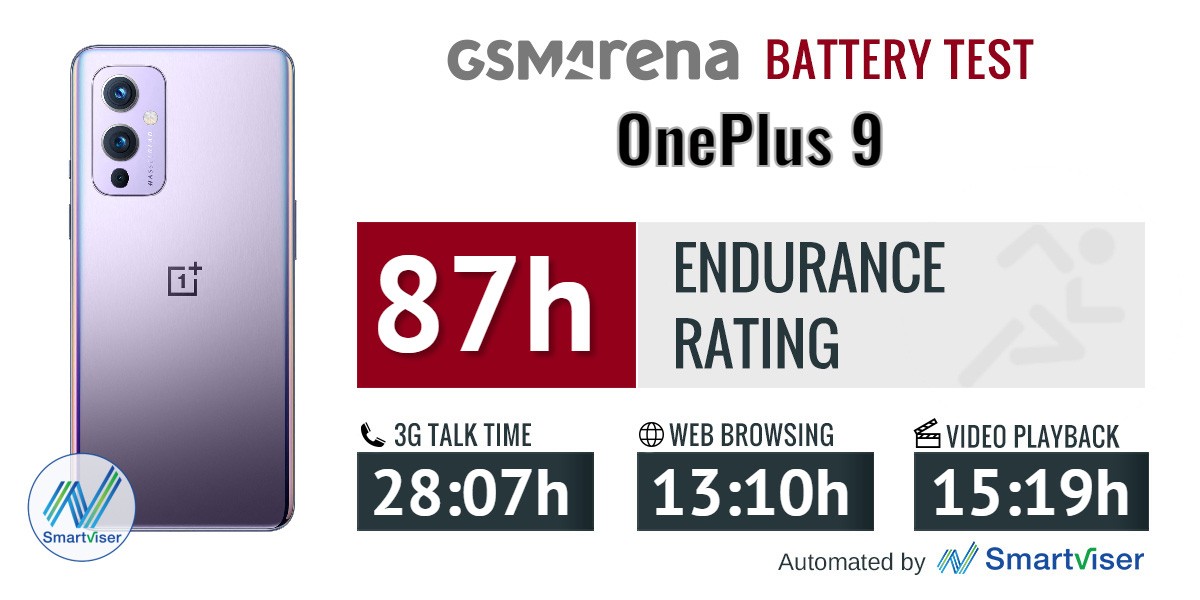
The OnePlus 9 tested for over 28h in talk time and surpassed 13 hours of the web test. It also scored more than 15 hours on the video playback test. Despite the phone's decent test scores, the Snapdragon 888's higher standby power draw hindered the OnePlus 9 from a better score. The OnePlus 9 weighed in at an 87h rating overall. Other contenders powered by the Snapdragon 888 like the Xiaomi MI 11 and Oppo's Find X3 Pro also had similar endurance scores attributed to high standby draw.
The OnePlus 8T fared better just six months ago with similar call, web, and video scores equipped with identical battery capacity. The Snapdragon 888 didn't do as well as the 865 in our standby tests. Perhaps these can be addressed as OEMs continue to optimize their devices in future OTA updates.
Our battery tests were automated thanks to SmartViser, using its viSerDevice app. The endurance rating above denotes how long a single battery charge will last you if you use the Poco X3 Pro for an hour each of telephony, web browsing, and video playback daily. We've established this usage pattern so that our battery results are comparable across devices in the most common day-to-day tasks. The battery testing procedure is described in detail in case you're interested in the nitty-gritty. You can check out our complete battery test table, where you can see how all of the smartphones we've tested will compare under your own typical use.
Charging
The 4,500 mAh battery on the 8T, 9, and 9 Pro all use identical dual-cell battery tech. This means that the adapter is simultaneously fast-charging two batteries that work as one. OnePlus debuted 65W charging with the OnePlus 8T, but the 9 and 9 Pro get a bump up in charging speed with Warp Charge 65T. Both phones received improvement that "reduces internal charging resistance" so the battery can accept peak wattage for longer times before dialing down.
30min charging test (from 0%)
- OnePlus 9
100% - Oppo Find X3 Pro
100% - OnePlus 9 Pro
99% - OnePlus 8T
94% - Huawei Mate 40 Pro (66W bundled)
87% - Xiaomi Mi 11
83% - OnePlus 8
69% - OnePlus 8 Pro
63% - Apple iPhone 12 Pro
59% - Apple iPhone 12
58% - Apple iPhone 12 Pro Max
55% - Samsung Galaxy S21 Ultra 5G
54% - Samsung Galaxy S21+ 5G
54% - OnePlus 8 Pro (Warp Charge Wireless)
48% - Google Pixel 5
41% - Huawei Mate 40 Pro (65W PD)
33%
Time to full charge (from 0%)
- Oppo Find X3 Pro
0:28h - OnePlus 9
0:29h - OnePlus 9 Pro
0:32h - OnePlus 8T
0:36h - Huawei Mate 40 Pro (66W bundled)
0:45h - Xiaomi Mi 11
0:50h - OnePlus 8
0:53h - Samsung Galaxy S21 Ultra 5G
1:11h - Samsung Galaxy S21+ 5G
1:12h - Apple iPhone 12
1:30h - Apple iPhone 12 Pro
1:30h - Apple iPhone 12 Pro Max
1:32h - Huawei Mate 40 Pro (65W PD)
1:42h - Google Pixel 5
1:54h
With Warp Charge 65T, the 9's battery was fully replenished in 29 minutes, just as OnePlus promised. This is a full 10-minutes faster than the OnePlus 8's 39-minute full charge. The included Warp charger can be used to charge non-OnePlus devices at a maximum of 45W if they support USB PD or PPS.
Although the OnePlus 9 Pro supports the new Warp Charge 50 Wireless charger, this isn't the case with the 9. The non-Pro model gets support for 15W fast wireless charging and reverse wireless charging at up to 5W. Wireless charging is equipped on the OnePlus 9 - but only in North American and European variants.
Speaker test
The OnePlus 9 has a stereo speaker setup with a dedicated loudspeaker on the bottom of the phone and the earpiece serving as the second channel. In portrait, the earpiece get the left channel, while in landscape the phone uses the accelerometer to switch the channels to match the orientation.
A 'Very Good' rating is what the OnePlus 9 got for loudness in our test, essentially the same result as the OnePlus 9 Pro even though the numbers are marginally different.
Use the Playback controls to listen to the phone sample recordings (best use headphones). We measure the average loudness of the speakers in LUFS. A lower absolute value means a louder sound. A look at the frequency response chart will tell you how far off the ideal "0db" flat line is the reproduction of the bass, treble, and mid frequencies. You can add more phones to compare how they differ. The scores and ratings are not comparable with our older loudspeaker test. Learn more about how we test here.
OxygenOS 11
OnePlus' OxygenOS has come a long way. With version 11, the UI was tweaked with large displays in mind. Many of the built-in apps and settings screens are designed with controls and tabs in the middle and lower portions of the screen to make them easier to reach one-handedly.
One new feature debuting with Oxygen OS on the 9 Pro takes place in the background. Turbo Boost 3.0 combines both RAM compression and Virtual RAM to let you keep up to 25% more apps open in the background. Virtual RAM reserves a small chunk of storage to temporarily be used as RAM when the main modules are at capacity.
The OnePlus 8T review noted all the changes (though not too major) on Oxygen OS 11. The 9 Pro launches with this same version of the OS so we'll just brush over the basics.
During setup, you'll be asked to choose between the default "Roboto" font and "OnePlus Sans". The latter is a light font with a modern look, but some may prefer the former for its superior legibility. You can change this later in the "Customization" tab under Settings.


Font choices
The fingerprint scanner is significantly lower on the display and it doesn't really interfere much with its usability. At most, it may take a couple of days to get used to its new location if you're coming from another OnePlus device.



Fingerprint setup
Home screens
With Oxygen OS 10.5, OnePlus moved the "OnePlus Shelf" from the left of the home screens to a secondary pull-down shade. The Google Feed now lives on the leftmost home screen. The home screen grids can be adjusted in the home screen settings - the default grid is 5x5. Icons can be switched from the default round to square ones as seen on Hydrogen OS, the Chinese counterpart to Oxygen OS. In more recent developments, OnePlus announced that new OnePlus devices in China will launch with a customized variant of Oppo's Color OS Android skin.


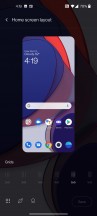
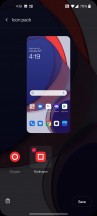
Home screen • Google Feed • Grid setting • Icons
Notification shade
The notification shade features six Quick Settings at the top, a brightness slider, and media controls if they are available. Below this top cluster is where notifications (both audible and silent) will populate. There are even more Quick Settings available to add and rearrange.
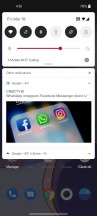
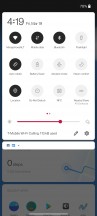


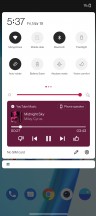
Notification shade • Quick Settings • More Quick Settings • Media Controls
The other pull-down drawer is the OnePlus Shelf and to access it, you swipe down on any area of the Oxygen OS launcher's home screens. The notification shade is accessed by swiping down from the very top.
The Shelf can be customized with preloaded tools like a step counter, weather widget, and a parking widget. Additional third-party widgets can be added here as well. Think of this as a customizable place for your favorite shortcuts and widgets that won't take up space on any of the home screens.


OnePlus shelf
The settings for Ambient Display are all in the "Customization" tab in the Settings app. Here you can change the accent color, system icons, wallpapers, font, and the Ambient Display clock.
Insight is the Ambient clock that also offers a glimpse as your phone's usage, showing you how often you unlock the screen throughout the day.






Customization: main screen • accent • tile shape • Ambient clock • Insight
OxygenOS 11 is great on the 9. It's no longer as stock as it used to be, but it looks, moves smoothly, and it's fast. OnePlus has managed to add plenty of function and features without bogging down the overall user-experience, all while keeping things clean. Settings aren't perfectly organized, but that's true of many Android skins these days.
There is still no dedicated one-handed mode in OxygenOS 11, though this is a feature that's evidently coming to the next major Android release.
Performance
The OnePlus 9 and 9 Pro are the few first devices that arrive to market with Qualcomm's latest mobile chipset built on the 5nm fabrication process. The Snapdragon 888 Mobile Platform powers both devices with an embedded X60 5G modem.
The Snapdragon 888 is an eight-core processor made up to three clusters that overperforms the Snapdragon 865 by up to 25% with better efficiency. The top cluster is a single 2.84GHz Kryo 680 Prime using ARM's Cortex-X1 design. Then there's a triple core made up of Kryo 680 Gold cores @ 2.42GHz based on Cortex-A78. Finally, there's a quad-core cluster of efficient and low-power Kryo 680 Silver cores clocked at 1.8GHz.
Powering graphics is the Adreno 660 GPU that promises a 35% increase in performance over the Adreno 650. It supports Open GL ES 3.2, Vulcan 1.1, and a new variable rate shading technology.
Both the OnePlus 9 and 9 Pro come with LPDDR5 RAM that the company claims can run at speeds of up to 6,400 Mbps and UFS 3.1 storage (non-expandable).
Cool Play is another feature that's on both the 9 and 9 Pro. It introduces thicker graphite sheets, larger copper foil, and a larger vapor chamber that helps to divert heat generated from playing games into the frame where it can be dissipated from the phone's panes of glass. The 9 Pro has a "Hyper Touch" feature that syncs the digitizer to supported games faster, but this feature is absent from the OnePlus 9.
Let's get into the benchmarks!
In the first benchmark, the OnePlus 9 scored just behind the 9 Pro, though the difference is not significant. Both still find themselves behind the Asus ROG Phone 5, though ahead of the remaining Snapdragon 888-powered phones. The 9 was slightly bested by the Huawei Mate 40 Pro, albeit only with that phone's "Performance mode" enabled.
Single-core scores are nearly uniform across all the recent flagships. Apple still leads the charts with its A14 Bionic chip in both single and multi-core tests.
GeekBench 5 (multi-core)
Higher is better
- Apple iPhone 12
4067 - Apple iPhone 12 Pro
4056 - Asus ROG Phone 5 (X Mode+ FAN)
3745 - Asus ROG Phone 5
3710 - Asus ROG Phone 5 (X Mode)
3709 - Huawei Mate 40 Pro (perf. mode)
3704 - OnePlus 9 Pro
3636 - OnePlus 9
3629 - Samsung Galaxy S21 Ultra 5G
3518 - Xiaomi Mi 11
3489 - OnePlus 8 Pro (120Hz, 1440p)
3374 - Oppo Find X3 Pro
3316 - Huawei Mate 40 Pro
3275 - Samsung Galaxy S21 Ultra 5G (Snapdragon)
3244 - Huawei P40 Pro+
3203 - OnePlus 8T
3126 - OnePlus 7 Pro
2721 - OnePlus Nord
1953 - Google Pixel 5
1647
GeekBench 5 (single-core)
Higher is better
- Apple iPhone 12 Pro
1611 - Apple iPhone 12
1605 - OnePlus 9
1129 - Asus ROG Phone 5 (X Mode+ FAN)
1127 - OnePlus 9 Pro
1126 - Asus ROG Phone 5 (X Mode)
1121 - Asus ROG Phone 5
1110 - Samsung Galaxy S21 Ultra 5G (Snapdragon)
1109 - Samsung Galaxy S21 Ultra 5G
1107 - Xiaomi Mi 11
1085 - Huawei Mate 40 Pro (perf. mode)
1020 - Oppo Find X3 Pro
926 - Huawei Mate 40 Pro
920 - OnePlus 8 Pro (120Hz, 1440p)
902 - OnePlus 8T
893 - Huawei P40 Pro+
781 - OnePlus 7 Pro
720 - OnePlus Nord
610 - Google Pixel 5
594
The OnePlus 9's graphics performance is excellent. The ASUS ROG Phone 5 was able to squeeze a few more frames out but the difference is negligible. The ROG Phone 5 has active cooling work in its favor, though. GPU performance is right in line with the other Snapdragon 888 performers from Xiaomi and Oppo, as well as Huawei's Kirin 9000 that fell a bit further behind.
GFX Manhattan ES 3.1 (offscreen 1080p)
Higher is better
- Apple iPhone 12
132 - Apple iPhone 12 Pro
132 - Asus ROG Phone 5 (X Mode)
123 - Asus ROG Phone 5 (X Mode+ FAN)
123 - Asus ROG Phone 5
122 - OnePlus 9 Pro
119 - OnePlus 9
119 - Huawei Mate 40 Pro (perf. mode)
117 - Oppo Find X3 Pro
113 - Xiaomi Mi 11
111 - Samsung Galaxy S21 Ultra 5G (Snapdragon)
109 - Samsung Galaxy S21 Ultra 5G
107 - Huawei Mate 40 Pro
97 - OnePlus 8T
88 - OnePlus 8 Pro (120Hz, 1440p)
86 - Huawei P40 Pro+
76 - OnePlus 7 Pro
68 - OnePlus Nord
38 - Google Pixel 5
22
GFX Car Chase ES 3.1 (offscreen 1080p)
Higher is better
- Asus ROG Phone 5 (X Mode)
72 - Asus ROG Phone 5 (X Mode+ FAN)
72 - Asus ROG Phone 5
71 - OnePlus 9 Pro
70 - OnePlus 9
70 - Oppo Find X3 Pro
70 - Xiaomi Mi 11
67 - Samsung Galaxy S21 Ultra 5G (Snapdragon)
66 - Apple iPhone 12 Pro
64 - Samsung Galaxy S21 Ultra 5G
64 - Huawei Mate 40 Pro (perf. mode)
64 - Huawei Mate 40 Pro
56 - OnePlus 8T
53 - Apple iPhone 12
53 - OnePlus 8 Pro (120Hz, 1440p)
51 - Huawei P40 Pro+
44 - OnePlus 7 Pro
41 - OnePlus Nord
21 - Google Pixel 5
13
3DMark Wild Life Vulkan 1.1 (offscreen 1440p)
Higher is better
- Huawei Mate 40 Pro (perf. mode)
6679 - Huawei Mate 40 Pro
6170 - Asus ROG Phone 5 (X Mode+ FAN)
5763 - Asus ROG Phone 5
5744 - Asus ROG Phone 5 (X Mode)
5740 - OnePlus 9 Pro
5701 - Samsung Galaxy S21 Ultra 5G
5691 - Xiaomi Mi 11
5673 - OnePlus 9
5667 - Oppo Find X3 Pro
5653 - Samsung Galaxy S21 Ultra 5G (Snapdragon)
5547 - Google Pixel 5
1033
On-screen tests scored in favor of the OnePlus 9 thanks to its screen's Full HD+ resolution. The Asus ROG Phone 5 showed up the other contenders.
GFX Manhattan ES 3.1 (onscreen)
Higher is better
- Asus ROG Phone 5 (X Mode+ FAN)
104 - Asus ROG Phone 5
103 - Asus ROG Phone 5 (X Mode)
103 - Huawei Mate 40 Pro (perf. mode)
78 - Huawei Mate 40 Pro
64 - OnePlus 9
60 - OnePlus 8T
60 - Apple iPhone 12
60 - Apple iPhone 12 Pro
60 - Samsung Galaxy S21 Ultra 5G
58 - Samsung Galaxy S21 Ultra 5G (Snapdragon)
58 - OnePlus 9 Pro
57 - Xiaomi Mi 11
57 - Oppo Find X3 Pro
55 - Huawei P40 Pro+
52 - OnePlus 8 Pro (120Hz, 1440p)
43 - OnePlus Nord
34 - OnePlus 7 Pro
33 - Google Pixel 5
22
GFX Car Chase ES 3.1 (onscreen)
Higher is better
- Asus ROG Phone 5
59 - Asus ROG Phone 5 (X Mode)
59 - OnePlus 9
58 - Apple iPhone 12
58 - Apple iPhone 12 Pro
58 - Asus ROG Phone 5 (X Mode+ FAN)
58 - OnePlus 8T
46 - Huawei Mate 40 Pro (perf. mode)
43 - OnePlus 9 Pro
36 - Samsung Galaxy S21 Ultra 5G
33 - Samsung Galaxy S21 Ultra 5G (Snapdragon)
33 - Oppo Find X3 Pro
33 - Xiaomi Mi 11
33 - Huawei P40 Pro+
31 - Huawei Mate 40 Pro
25 - OnePlus 8 Pro (120Hz, 1440p)
24 - OnePlus 7 Pro
19 - OnePlus Nord
19 - Google Pixel 5
12
The 9 performed very well in the Antutu run, scoring neck-to-neck with the powerful Asus ROG Phone 5. Both of these were still ahead of the Huawei Mate 40 Pro and the other devices powered by the same chipset.
AnTuTu 8
Higher is better
- Asus ROG Phone 5 (X Mode+ FAN)
718864 - OnePlus 9
715196 - Asus ROG Phone 5 (X Mode)
708531 - Asus ROG Phone 5
708216 - OnePlus 9 Pro
691055 - Huawei Mate 40 Pro (perf. mode)
686835 - Xiaomi Mi 11
668722 - Samsung Galaxy S21 Ultra 5G (Snapdragon)
657273 - Samsung Galaxy S21 Ultra 5G
657150 - Oppo Find X3 Pro
656467 - Apple iPhone 12 Pro
596244 - Apple iPhone 12
579048 - OnePlus 8T
576625 - OnePlus 8 Pro (120Hz, 1440p)
573276 - Huawei Mate 40 Pro
531270 - Huawei P40 Pro+
529687 - OnePlus Nord
312794 - Google Pixel 5
289261
There's nothing to complain about in term of performance. The OnePlus 9 packs plenty of computing power to handle graphic-intensive games and resource heavy editing apps. Add to that the UFS 3.1 storage and you have yourself a well-primed machine.
The Cool Play feature works as advertised. Though the heat does originate from the upper half of the back of the phone, heat was well dissipated throughout the phone's frame and both panes of glass. It never got uncomfortably warm, even through multiple matches.
We ran the 3D Mark Wild Life Stress Test and the OnePlus 9 showed 55.9% stability at the 120Hz refresh rate. Frame rates began to drop around the seventh loop and bottomed out at the thirteenth.
An upgraded camera system
The OnePlus 9 has a triple camera system on the back, consisting of a wide, ultra-wide, and monochrome camera.
The main wide camera on the OnePlus 9 is the same Sony IMX689 borrowed from the OnePlus 8 Pro. It has a 48-megapixel resolution, 23mm equivalent lens with an f1.8 aperture, and OIS. The ultra-wide camera is shared with the OnePlus 9 Pro. It's the Sony IMX766 with a 50-megapixel resolution and 14mm equivalent f2.2 7P freeform lens. This camera also does double duty as a macro camera.
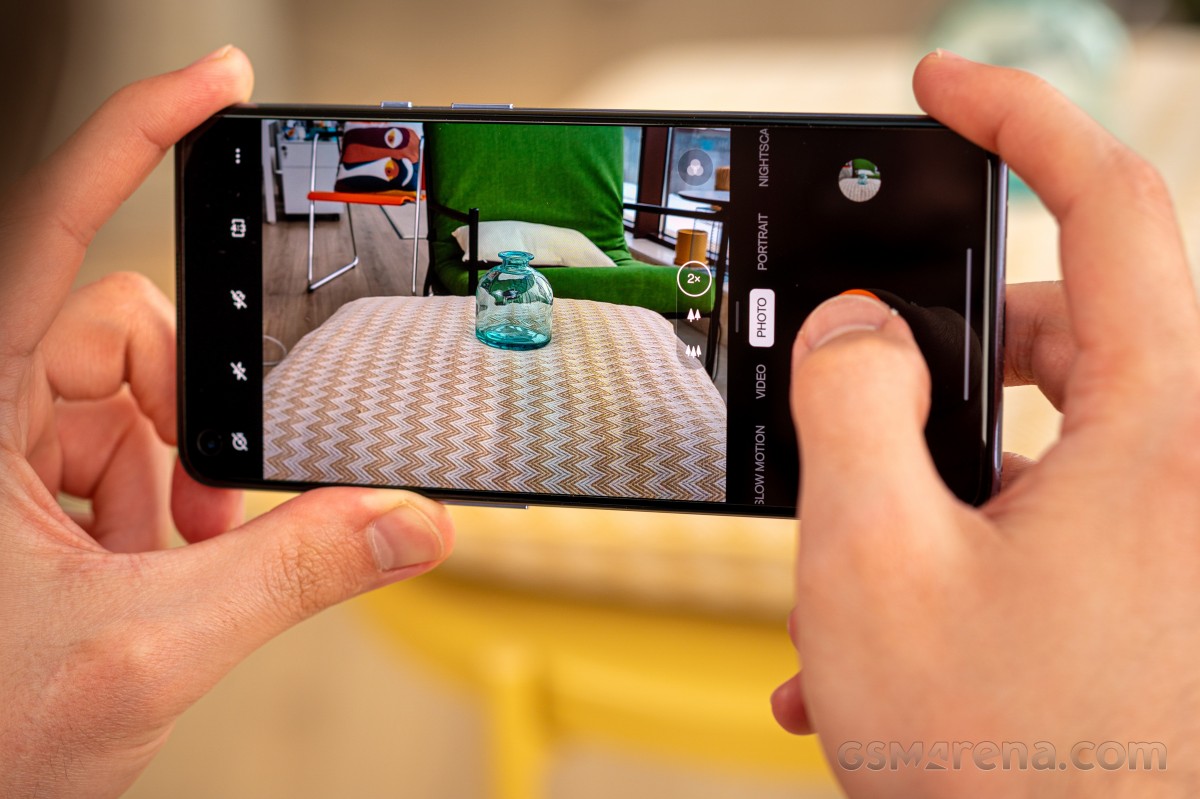
The OnePlus 9 does not have a dedicated telephoto camera as all zooming is done digitally. Instead, we get a 2-megapixel monochrome camera, which we will get to later.
Unlike the OnePlus 9 Pro or even the OnePlus 8T, the OnePlus 9 does not have OIS. This means all stabilization for photos and videos is done digitally.
Like the bigger OnePlus 9 Pro, the OnePlus 9 has been blessed by Hasselblad's camera engineers The OnePlus 9 uses the new Natural Color Calibration method devised by Hasselblad and optimized for this hardware. At least, that's what it says on paper.
Camera app
The OnePlus 9 comes with a new camera app, which features some notable changes and improvements over the app found on previous-generation models. The most striking change is the use of a new camera shutter button, with OnePlus opting for the distinctive orange color as seen on the shutter buttons on Hasselblad cameras. The shutter sound has also been changed to match Hasselblad cameras.



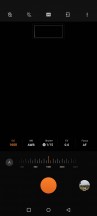
Camera app
The bulk of the changes in the camera app are in the Pro mode. Here, we find the updated UI for the adjustment dials for parameters such as ISO, white balance, shutter speed, exposure compensation, and focus. Instead of the rotating wheel in the previous app, the OnePlus 9 Pro has a straightforward horizontal bar that can be swiped up and down. This is much easier to adjust than the rotating wheel of before and the auto mode switch is always visible rather than being at some arbitrary point on the wheel that you have to spin to.



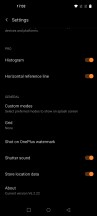
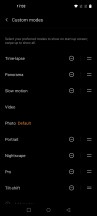

Camera app
Unfortunately, that's pretty much the extent of the improvements in the camera UI. There are still some issues, which we would have liked OnePlus to have fixed by now. Manually adjusting the exposure in Auto mode is still a nightmare, with a tiny slider that's hard to adjust and an even tinier icon to lock it. The zoom control dial is still annoyingly finicky and getting an exact figure dialed in is a test of patience. This would have been a good time to replace with a vertical slider like for the settings in Pro mode, but that hasn't happened.
The UI also doesn't rotate when held in landscape. Trying to quickly open the settings menu while in landscape mode is a laughably bad experience, as the screen stays resolutely in portrait mode, even if you have auto-rotate enabled. The settings icon is also quite small and difficult to press.
Lastly, the Pro mode still doesn't allow you to access any other camera. This means you are strictly limited to the main wide camera on the back if you want full control or the ability to shoot in RAW. There's also no Pro mode available for video.
Daylight performance
We will start with the daylight performance of the main camera, which is perhaps the most common use-case scenario for most people.
Starting with the detail, the OnePlus 9 camera does relatively well here. The final images have a decent amount of detail considering they are only 12-megapixels. There are some textures that can occasionally turn soupy, especially in low-frequency detail areas, and the switch to a wider focal length from the 8 Pro has resulted in a slight loss in detail due to cramming in more area into the same frame. OnePlus has turned up the sharpening to compensate for that, which often looks quite unpleasant while viewing the image up close.












Daylight 12MP samples
The OnePlus 9 images can also be surprisingly noisy, even in broad daylight at the lowest ISO. This is something we saw on the OnePlus 9 Pro as well and seems to be endemic to the tuning done on these two devices. The thing is, the noise isn't even found in the RAW files so either this is an artistic decision or the sensors are being pushed too far during HDR tone mapping or other image processing. Either way, it doesn't look good, especially when you crop in.







Daylight 48MP samples
The color performance on the OnePlus 9 is decent. Under bright daylight conditions, the colors in the scene come out looking fairly neutral although the camera does have a tendency to saturate the greens under bright light. This is similar to the OnePlus 8 Pro, which the OnePlus 9 shares its camera with, but better than the OnePlus 8 and 8T, which had a much older sensor. Those devices often showed worse color performance, especially in challenging lighting conditions, but the OnePlus 9 fares a lot better in comparison.
The dynamic range performance isn't quite on par with some other devices on the market. Although the camera does well to control the highlights, the shadows are often darker than we'd have liked. This seems like a creative decision to produce more contrasty images, and some people may prefer the images this way, but we think the images should have as much dynamic range as they naturally can for maximum detail and flexibility in post-processing. It's easier to crush shadows later in post than to bring them back.
An easy fix for this, however, is to shoot in Pro mode. Even the JPEGs shot in Pro mode have much more dynamic range and shadow details and also significantly less oversharpening. For ultimate flexibility in post, you can choose to enable saving the RAW files. The RAW files from the OnePlus 9 have an impressive level of detail from the sensor and the files are quite malleable, even if you plan on pushing them aggressively in edit. There's also surprisingly less noise in the RAW files than in the standard JPEGs and even when the noise does creep in at higher ISO values, it's a more pleasing grain than the coarse grain in the default JPEGs.
Moving on to the ultra-wide, the OnePlus 9 uses the same new 50-megapixel sensor as the OnePlus 9 Pro. This is a vastly superior sensor than what we have seen previously on OnePlus phones and is capturing an impressive amount of detail for an ultra-wide, even though the final images are still saved in 12.5-megapixel resolution. The freeform lens design also gets rid of distortion entirely, allowing straight lines to appear straight even around the edges.








Daylight 12.5MP ultra-wide samples
Unfortunately, this camera also suffers from the same basic color calibration issues as the main camera. This means there is still a ton of noise in the images, lots of oversharpening, and the shadows are often crushed far too much for a contrasty look. This time, however, there is no Pro mode that can come to your rescue, as only the main camera is accessible in that mode.
The OnePlus 9 does not have a dedicated telephoto lens. Instead, the camera performs a digital zoom on the main camera. The default multiplier is 2x through the quick toggle but you can just go as high as 10x.







Daylight 2x digital zoom samples
The image quality is nothing to write home about, even in the most basic 2x mode. The details are soft and the results look on par with what you'd expect if you just manually zoomed into an image while editing. The OnePlus 9 also doesn't seem to be using a crop from the center of the sensor as on the OnePlus 8T and instead is just blowing up the 12-megapixel image, which further makes the image appear fuzzy. Also, the lack of OIS on the OnePlus 9 becomes apparent the more you zoom in.
The macro functionality on the OnePlus 9 is handled by the new ultra-wide lens. We think this is ideally the way to go, as the dedicated macro cameras on most phones are rather abysmal due to their low resolution, low-quality sensors. The ultra-wide camera on the OnePlus 9 can take some really good-looking macro images. This camera cannot get as close to the subject as some of the dedicated macro cameras on the market but in most cases, that's fine, and getting too close with smartphone risks covering the subject with your shadow.




Macro samples
Lastly, there's the monochrome camera. We already covered this back with the OnePlus 8T but just to give a quick summary, the monochrome camera doesn't itself capture images but rather assists the main camera in producing monochrome images. This sensor doesn't have a color filter of its own so the camera uses the information from this image to "color" the images from the main sensor.
As we mentioned in the 8T review, the results aren't anything you wouldn't get by simply editing a standard color image or shooting in one of the other monochrome presets in the Camera app. The fact that OnePlus felt this is worth including for the second time in a row shows how desperate smartphone companies can get these days just to pad their spec sheets and have that one extra camera.
Low light performance
The OnePlus 9 has an impressive low-light performance. Even without enabling Nightscape, you can get some good results, with decent detail, exposure, and color accuracy. The results are on par with what you'd get with the OnePlus 8 Pro and much ahead of the OnePlus 8T, although the OnePlus 9 Pro is still a bit better here with more detail.








Low light main samples
With Nightscape enabled, the OnePlus 9 manages to catch up with the OnePlus 9 Pro as there's not much separating the two. Both can capture excellent low-light images with this mode enabled, with good detail, exposure, and color. In comparison, the OnePlus 8 Pro is a close second while the OnePlus 8T lags far behind with often odd-looking colors with a strong magenta color cast.








Low light main Nightscape samples
As for the new ultra-wide lens, it is significantly better than the ultra-wide on the 8 Pro and in a different league altogether compared to the anemic sensor on the 8T. While the standard mode images may not be always usable, the Nightscape images look great under most conditions.








Low light ultra-wide samples








Low light ultra-wide Nightscape samples
Like the OnePlus 9 Pro, you cannot use the zoom mode in Nightscape. Considering it is all-digital on the OnePlus 9, this isn't a big loss.
Portraits
The OnePlus 9 can only shoot portrait images with the main camera. The default setting is to launch the camera in a digitally zoomed-in mode that mimics the look of a 2x telephoto lens. While this will help reduce the distortion, it does result in softer images. Alternatively, you can switch to using the maximum focal length of the main lens for a wider but distorted perspective.




Portrait samples
The Portrait mode also enables the background blur on the subject. As is usual for OnePlus phones, there is no way to dial in the exact amount of blur that you want, which means the end results can often be a bit of a hit or miss affair. Sometimes the somewhat aggressive blur looks good, other times it can cause the subject to stick out too much from the background and look like a cardboard cutout.
Selfies
The OnePlus 9 has a 16-megapixel f2.4 fixed-focus camera. This is the same Sony IMX471 that has been the staple of OnePlus phones going back all the way to the OnePlus 7 Pro.
It's clear why OnePlus continues to rely on this sensor, as it provides a good level of detail, decent color performance, and adequate dynamic range for portrait images captured in daylight.




Selfie samples
Where it falls behind is in low-light performance as there's no Nightscape for the front camera. The camera also lacks autofocus and the video resolution is limited to just 1080p60. Also, while the field of view is adequate for one person, it will feel more restrictive compared to some of the wider cameras on the market, including OnePlus's own Nord that comes with a separate ultra-wide front camera and even 4K recording.

Selfie portrait mode samples
The front camera is capable of shooting in portrait mode. Once again, the lack of control over the background blur makes the results inconsistent, especially when the subject separation goofs up. We hope OnePlus starts offering these basic features in its camera app as most of its competitors have been doing for several years now.
Video
The OnePlus 9 is capable of recording video in 1080p, 2160p (4K), and 4320p (8K). The main wide camera can shoot 1080p video in 30 and 60fps, 4K video in 30 and 60fps, and 8K video in 30fps. The ultra-wide camera can shoot 1080p video in 30 and 60fps, 4K video in 30 and 60fps, and 8K video in 30fps. All zooming is done digitally.
Video in all resolutions and frame rates is shot by default in H.264 but you can optionally switch to H.265 to save some storage space without sacrificing image quality.
EIS is available in 30 and 60fps modes but not for the 120fps mode. As usual, the EIS has a massive crop in modes where it's available but there's no way to disable it.
Additionally, there are also two slow-motion modes: 1080p 240fps and 720p 480fps, which save slowed-down footage. The Super Stable mode uses the ultra-wide camera and then crops into a perspective similar to the main wide camera and then uses that to heavily stabilize the footage. The Nightscape mode enables night mode for video on the main camera. Lastly, the Portrait mode works similar to the feature available for images, isolating the subject from the background using an artificial blur. Super Stable, Nightscape, and Portrait mode all save videos in 1080p only.
The OnePlus 9 offers a feature called 3-HDR, which is a rebranding of a feature called Dynamic Video on the OnePlus 8 Pro. This feature captures three exposures at different values for every frame and then merges them for a wider dynamic range. It can be toggled on or off but is only available in 1080p 30fps and 4K 30fps modes.
The OnePlus 9 Pro does not support recording video in proper 10-bit HDR PQ video in either HDR10 or any of the other standards. As mentioned previously, there is also no pro mode for video so there's no real control over the image other than adjusting the resolution and frame rate.
Starting with the 4320p 8K video from the main camera, the image quality is unimpressive. We are talking about a 33-megapixel image here and the level of detail doesn't come anywhere close to that figure. The bitrate of a measly 150Mbps (H.264) is to blame here as is the general structure of these Quad Bayer sensors. This isn't to say there isn't any meaningful improvement over the 4K version but it's not what one would expect from a quadrupling of resolution.
The 8K video shot from the ultra-wide camera is, simply put, not real 8K. The video is most likely upscaled from a lower resolution image, and has blurry details and what looks like horizontal interlacing artifacts all over the image. This actually makes the 8K video from the ultra-wide camera look worse than even the 4K version.
Moving over to 4K, both the 30fps and 60fps videos from the main and ultra-wide cameras show good detail, dynamic range, and overall image quality. The stabilization works well most of the time but can struggle a bit when you're trying to pan and it keeps trying to stabilize the movement.
Unfortunately, the stabilization comes at a significant crop to the final image, nearly 1.5x of the full width of the sensor. This effectively turns the main camera into a telephoto lens and makes subject framing difficult at close distances.
The 3-HDR feature also works really well and would be our recommended option if you are recording outdoors under bright sunlight at 30fps. The dynamic range is much better with improved shadow detail and the image looks generally well-exposed and more natural.
The OnePlus 9 Pro also supports Nightscape and Portrait mode videos. The results from these modes are underwhelming and neither is particularly good or useful.
Camera conclusions
Unlike the OnePlus 9 Pro, which had a fairly proficient predecessor to outshine, the OnePlus 9 scores an easy victory over the mediocre OnePlus 8T. The main camera captures better colors, dynamic range, and detail across the board and the new ultra-wide camera is just light years ahead. Low Light camera performance is also vastly improved as is video performance, especially when shooting with the ultra-wide.
What we didn't see much evidence of is the new Hasselblad color science. Sure, the colors are better compared to the OnePlus 8T but that was the case with the OnePlus 8 Pro as well last year. In fact, we think that the OnePlus 8 Pro often captures better-looking images than either of the two new OnePlus 9 phones, with more accurate colors, better detail, less oversharpening, and much less noise.
We also think OnePlus needs to do more in terms of improving its camera app, with a more user-friendly design and additional features, such as a Pro mode for video, HDR10 recording, adjustable background blur for portrait mode, and a less clumsy settings menu that doesn't stay locked in portrait orientation.
Overall, the OnePlus 9 gets a solid B+ for its efforts. However, there are better cameras now on the market at a lower price.
The competition
The OnePlus 9 starts at $729, which is a fairly serious price tag that gets it some fairly serious competition. For starters, it's more expensive than the Samsung Galaxy S21, which starts at $699 but can occasionally be found for a lower price. Probably the most underrated of the three new S21 phones, the standard S21 is still a great smartphone whose only real flaw is perhaps opting for a plastic back in a market full of glass phones.
But if that's a real deal-breaker to you or if you just want something larger, then there's the S21+, which goes for $799 or at times even $749. The S21+ is a fully-featured smartphone that leaves very little on the table and has the performance to match the price tag. Samsung may even throw in an accessory or two in some regions or offer a discount on them if you pick this up, which makes the deal even sweeter.



Samsung Galaxy S21 5G • Samsung Galaxy S21+ 5G • Asus ROG Phone 5 • Apple iPhone 12
The newly launched ASUS ROG Phone 5 is also a tough competitor in this segment. ASUS has not just chosen to pack this phone with as many features as possible but also opted for an aggressive pricing at around the same price as the OnePlus 9. While clearly marketed as a gaming phone (and it's a damn good at that), the ROG Phone 5 is also a fairly complete package, with respectable performance in nearly every area.
If you're looking for something a bit different, then maybe you'd want to consider the Apple iPhone 12. Possibly the best value iPhone in a while, the standard iPhone 12 manages to pack great design and build quality, a high quality display, best in class performance, a high quality set of cameras, easy to use software with unparalleled software and game library, legendary customer support and a high resale value to boot. The iPhone 12 will also be appealing to those who are looking for a more compact smartphone but for those who want something even smaller, there's the $100 cheaper iPhone 12 mini as well, which does basically everything the iPhone 12 does in a smaller size. Yes, the 60Hz display aren't exactly modern and the lack of any kind of charger in the box may be frustrating to some but as a complete package, the iPhone 12 is still hard to beat.
Verdict
From being the hero of its own story to becoming the sidekick, the non-Pro line of OnePlus phones has had a tragic demotion over the years. We first saw this with the OnePlus 7 and two years later, not much has changed.
It's clear the Pro device is going to get all the best stuff moving forward but at times it feels like OnePlus swings the cripple hammer too hard on the non-Pro mode. A plastic frame, no certified ingress protection, lower resolution display from last year's model, no telephoto camera and downgraded main sensor, no 4K 120fps recording, no OIS, and no wireless charging outside of NA and Europe.
As reviewers, it's hard to get excited about the OnePlus 9. Just as it was hard to get excited about the OnePlus 8 and the OnePlus 7. As a phone, it's perfectly adequate and for the most part it's quite nice to use. But at $729 starting price, it's supposed to be nice. The brakes on the OnePlus price hike train stopped working years ago and the company clearly has no plans on slowing down. So then why are things being taken away instead of being added?
We can't decipher these mixed signals. If the OnePlus 9 is available in your region at a reasonable price, then it is a reasonable phone to pick up. But if OnePlus wants to play the price hike game, it will have to do better at this.
Pros
- Good display performance
- Relatively clean software and great UI performance
- Powerful loudspeakers
- Good performance from the main wide and ultra-wide cameras
- Fast charging
Cons
- Plastic frame
- No official IP rating
- No OIS
- No dedicated telephoto camera
- Outdated front camera
- Hasselblad partnership mostly a marketing gimmick
- Monochrome camera is useless
- No wireless charging outside of NA and Europe
- Worse battery life performance than previous models
- Most games still locked to 60fps

No comments:
Post a Comment